Utility Terrain Vehicle Choosing the Right Size: Should Your Business Invest in a 2-Seat UTV or a 4-Seat UTV?
Crossover UTV Buyer’s Guide
For modern commercial operations, infrastructure expansion, and heavy-duty industrial management, investing in a Utility Terrain Vehicle (UTV) is no longer a luxury—it is a baseline operational necessity. However, when procurement managers and business owners transition from acknowledging the need for utility vehicles to executing a fleet purchase, they universally hit a critical logistical fork in the road: Should the business invest in a 2-seat UTV (the Work Mule) or a 4-seat UTV (the Crew Shuttle)?
Selecting the wrong configuration impacts more than just occupant capacity. It reverberates across your entire operational ledger, dictating your fleet’s maximum payload capacity, towing thresholds, maneuverability in dense forestry or confined construction corridors, Total Cost of Ownership (TCO), and workforce efficiency.
This comprehensive B2B buyer’s guide breaks down the engineering, mechanical, financial, and logistical variances between 2-seat and 4-seat commercial utility vehicles to ensure your next fleet acquisition aligns perfectly with your enterprise goals.
Crossover UTV Buyer’s Guide: Strategic Framework
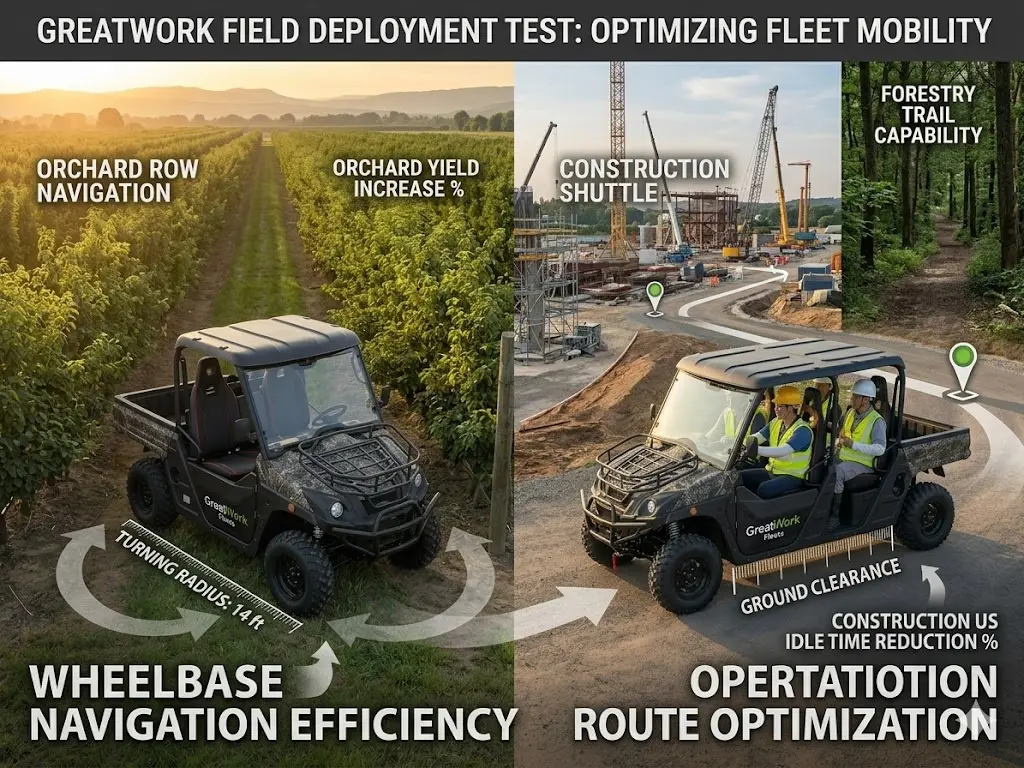
Figure: GreatWork fleet field deployment test illustrating the logistical advantages of 2-seat UTVs for navigation in tight orchard rows versus 4-seat UTVs for crew transport optimization on construction sites.
1. Chassis Engineering and Framework Variances
To make an informed B2B procurement decision, you must first understand the structural engineering differences that separate a 2-seat utility vehicle from its expanded 4-seat counterpart. These physical attributes directly govern how the machine handles under load, navigates terrain, and survives harsh industrial environments.
Wheelbase Length and Turning Radius
The most glaring mechanical divergence lies in the wheelbase length (the distance between the center of the front and rear wheels).
2-Seat (The Work Mule): Typically features a compact wheelbase ranging between 75 to 85 inches. This shorter footprint grants the vehicle an incredibly tight turning radius, allowing operators to execute sharp, fluid turns in heavily wooded sectors, tight orchard rows, or narrow warehouse lanes with absolute precision.
4-Seat (The Crew Shuttle): Requires an elongated frame to accommodate the secondary row of seating, pushing the wheelbase out to 105 to 118 inches. While this extension provides excellent longitudinal stability, it significantly increases the turning radius. In tight, enclosed spaces, a 4-seat model may require multi-point turns where a 2-seat model would clear seamlessly. This trade-off is critical for operations where space is at a premium.
Ground Clearance and Breakover Angle
In off-road operations, ground clearance alone does not determine whether a vehicle will get stuck. The critical metric is the breakover angle—the maximum angle a vehicle can drive over a peak without the undercarriage scraping or getting high-centered (“beached”).
Because 4-seat commercial UTVs have a significantly longer wheelbase while maintaining a similar ground clearance to 2-seat models, their breakover angle is inherently shallower. When traversing steep ridges, rocky pipeline easements, or abrupt construction debris, a 4-seat vehicle is at a much higher risk of scraping its underbelly. Conversely, a 2-seat UTV handles sharp crests and aggressive undulations with far greater mechanical ease. This design must be prioritized if your site features steep, unpredictable terrain.
When carrying heavy commercial loads or transporting a full crew over punishing terrain, suspension architecture is paramount. Premium commercial utility vehicles leverage a specialized application of the Double A-Arm suspension system on both the front and rear axles.
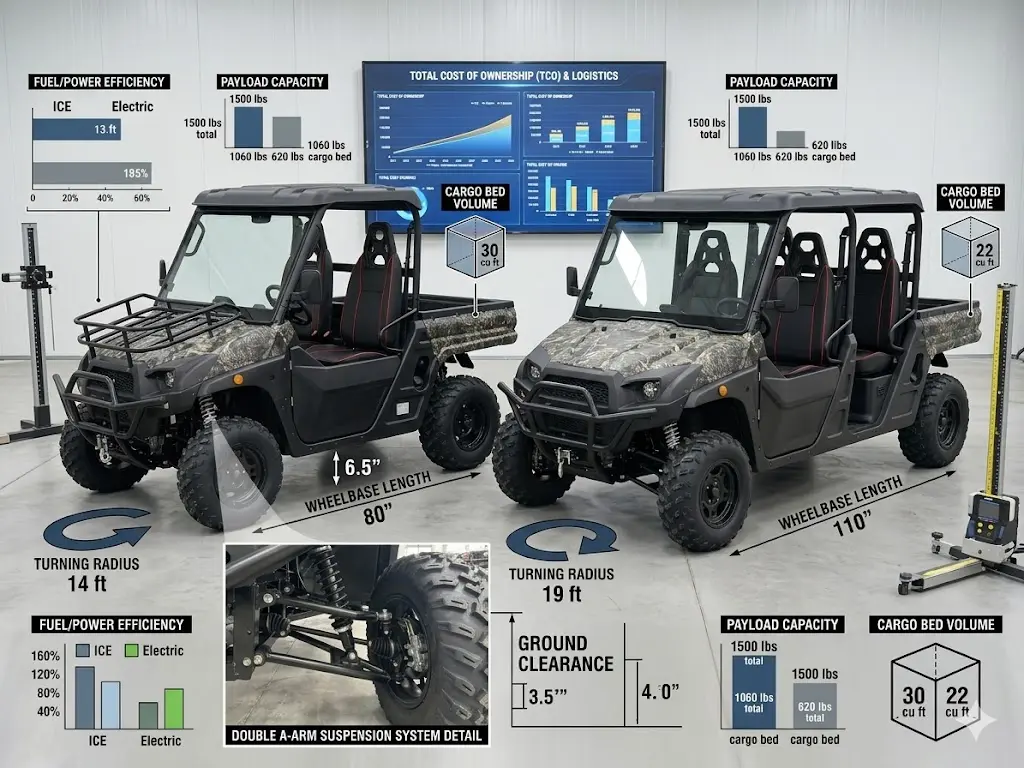
As defined in the technical component breakdown shown in Image 14, the Double A-Arm suspension system utilizes two wishbone-shaped arms to mount the wheel hub to the chassis. This engineering design ensures that as the suspension travels up and down over rocks, ruts, or mud, the wheel maintains a near-vertical alignment to the ground.
2-Seat (The Work Mule): The suspension is specialized and tuned for rapid responsiveness and high agility. This ensures maximum stability and traction when the vehicle is unladen or carrying a multi-terrain cargo load.
4-Seat (The Crew Shuttle): The suspension architecture must handle massive load variance—ranging from a single driver to four full-grown, gear-laden workers. Consequently, these commercial models employ heavy-duty, multi-link Double A-Arm suspension system configurations coupled with much stiffer, heavy-duty adjustable coil-over shocks. This advanced engineering prevents rear-end sag and maintains stable ground clearance under peak volume, ensuring a smooth and controlled crew transport.
Figure: Technical breakdown of GreatWork commercial UTVs, highlighting the specialized double A-arm suspension system and key dimensional differences between the 2-seat Work Mule and 4-seat Crew Shuttle configurations.
2. Payload Allocation vs. Occupant Volume: The Ultimate Operational Trade-Off
A common misconception among fleet procurement managers is that a larger vehicle automatically translates to a higher cargo-carrying capacity. The true critical metric is how the limited payload is conceptually allocated between occupants and cargo.
Understanding Cargo Bed Volume
On a standard 2-seat commercial UTV, the space directly behind the front seats is fully dedicated to the cargo bed volume. On many 4-seat UTVs, manufacturers must compromise by pulling the rear seats forward into the chassis footprint, which can result in a compressed cargo bed length. While some premium industrial-grade 4-seat models maintain a full-size bed, they do so by expanding the vehicle’s total length to nearly 160 inches, creating a massive machine that requires careful transport logistics.
Real-World Commercial Payload Allocation
Every vehicle is rated for a total maximum payload, which must accommodate all occupants, cabin gear, and cargo.
Scenario A: 2-Seat Deployment: A 2-seat Work Mule, deployed with two industrial workers, consumes relatively little of the vehicle’s total payload limit. The Work Mule can safely load nearly double the cargo weight of its 4-seat counterpart. This allows the crew to transport heavy bulk materials—such as cement bags, steel pipes, or heavy portable generators—directly in the rear dump bed without exceeding factory safety thresholds.
Scenario B: 4-Seat Deployment: Shuttling four technicians simultaneously represents a significant payload. While you have successfully maximized workforce transport, your available payload capacity for cargo has dropped by over half compared to the 2-seat model. If your team loads the compressed bed with heavy industrial tooling while carrying four occupants, they risk overloading the rear suspension and stressing the drivetrain.
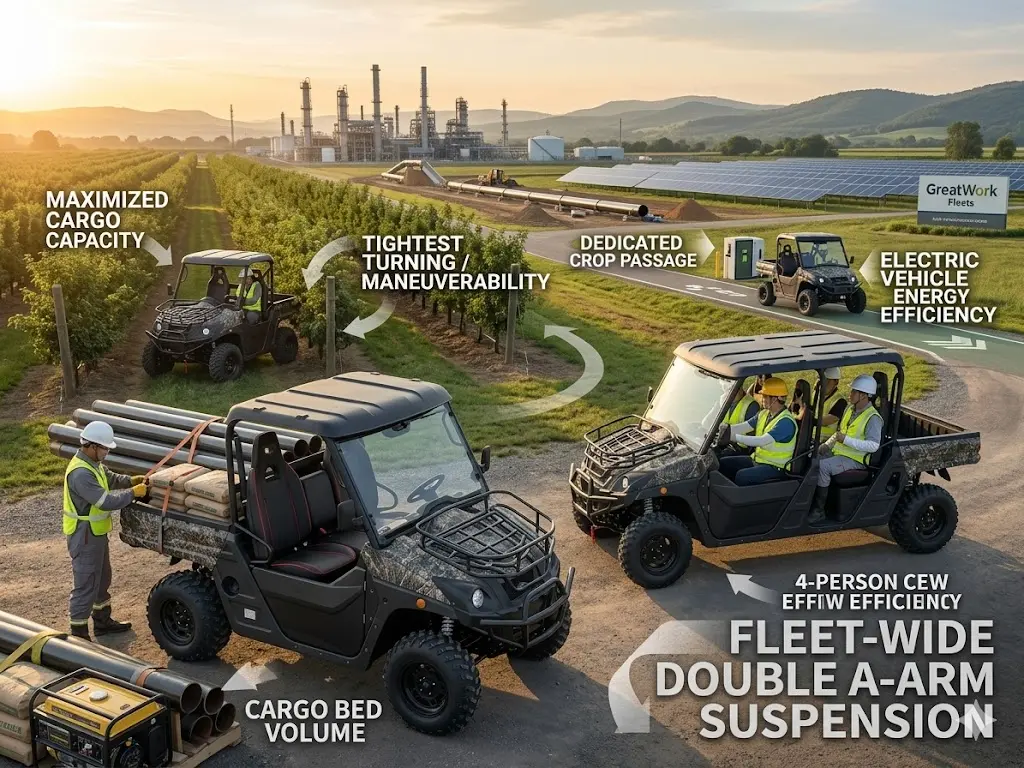
Figure 1: Choosing between a 2-seat work mule with tight turning radius and a 4-seat crew shuttle for industrial fleet optimization.
3. Industry-Specific Use Cases
Agricultural Operations & Commercial Forestry
In large-scale farming, orchard management, and commercial forestry, the 2-seat UTV reigns supreme.
Orchards & Vineyards: Tree canopies create incredibly tight clearances. A 2-seat vehicle can execute a U-turn at the end of an agricultural row without striking fruit-bearing branches.
Forestry: Navigating unmapped woodland trails requires a machine capable of dodging stumps. The Work Mule’s tighter turning radius prevents the vehicle from getting wedged in backwoods locations.
Construction Sites & Heavy Industrial Facilities
4-Seat (Crew Shuttle): Construction sites run on coordinated labor. A 4-seat UTV functions as an on-site crew transport vehicle, moving an entire team in a single pass to slash idle labor times.
2-Seat (Work Mule): For mechanics or safety inspectors traveling solo or in pairs with heavy gear, the 2-seater is the safer, more stable pack horse.
Resorts & Municipalities
For properties characterized by manicured turf, the priorities shift toward passenger volume and low ground impact. The 4-seat UTV is highly advantageous here, as moving a landscaping crew of four along with their tools in a single vehicle minimizes vehicular traffic on pedestrian walkways.
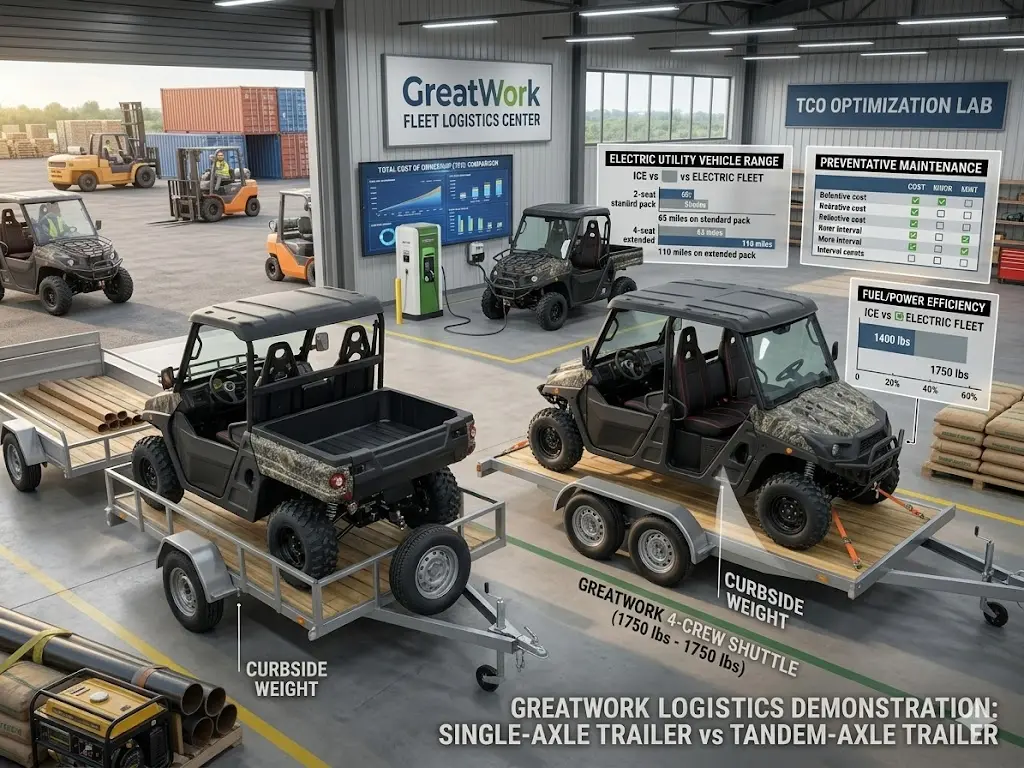
Figure: Transport logistics comparison illustrating that a 2-seat UTV fits on a standard single-axle trailer, while the 4-seat model requires a heavy-duty dual-axle tandem trailer for safe transport.
4. Drivetrain Engineering and Fleet Energy Efficiency
A 4-seat commercial UTV features a longer steel chassis and secondary seating, which increases the vehicle’s dry curbside weight by 250 to 400 lbs. This permanent weight premium means the engine or electric motor must work harder during acceleration, leading to a drop in fuel efficiency (for ICE models) or a higher battery draw (for electric utility vehicles).
If your facility requires long shifts with high daily mileage and no time for opportunity charging, a 2-seat [electric utility vehicle] will deliver better runtime per charge cycle. If a 4-seat model is mandatory, procurement teams should specify high-capacity lithium battery upgrades to offset the mass penalty.
5. Total Cost of Ownership (TCO) and Logistics
A professional B2B vehicle acquisition requires analyzing the long-term Total Cost of Ownership (TCO).
Initial Fleet Purchase Price: From a pure capital expenditure (CapEx) standpoint, 4-seat UTVs command a price premium due to additional raw materials and upgraded suspension components.
Preventative Maintenance: Because 4-seat units carry heavier continuous loads, they see faster tire wear, increased brake heat loading, and higher maintenance demands on suspension bushings compared to lighter 2-seat configurations.
Fleet Logistics: A 2-seat Work Mule (approx. 110-120 inches) fits onto a standard single-axle trailer. A 4-seat Crew Shuttle (up to 160 inches) requires a heavy-duty, dual-axle tandem trailer, which adds complexity to equipment transfers.
6. Strategic Decision Framework
Analyze the “Crew-to-Cargo” Ratio: If >70% of operations involve heavy hauling, choose a 2-seat UTV. If >70% involves moving crews, choose a 4-seat UTV.
Survey Spatial Boundaries: If you operate in tight orchard rows or narrow aisles, a 2-seat UTV is required to clear the tight turning radius without sustaining damage.
Audit Energy Goals: For electric utility vehicle fleets, 2-seat models offer superior range, while 4-seat models require upgraded battery configurations to maintain uptime.