Mastering the Wild: The Ultimate Guide to Modern Off-Road UTV Performance
This Crossover UTV Buyer’s Guide is designed to help businesses optimize their fleet management by comparing key performance metrics.
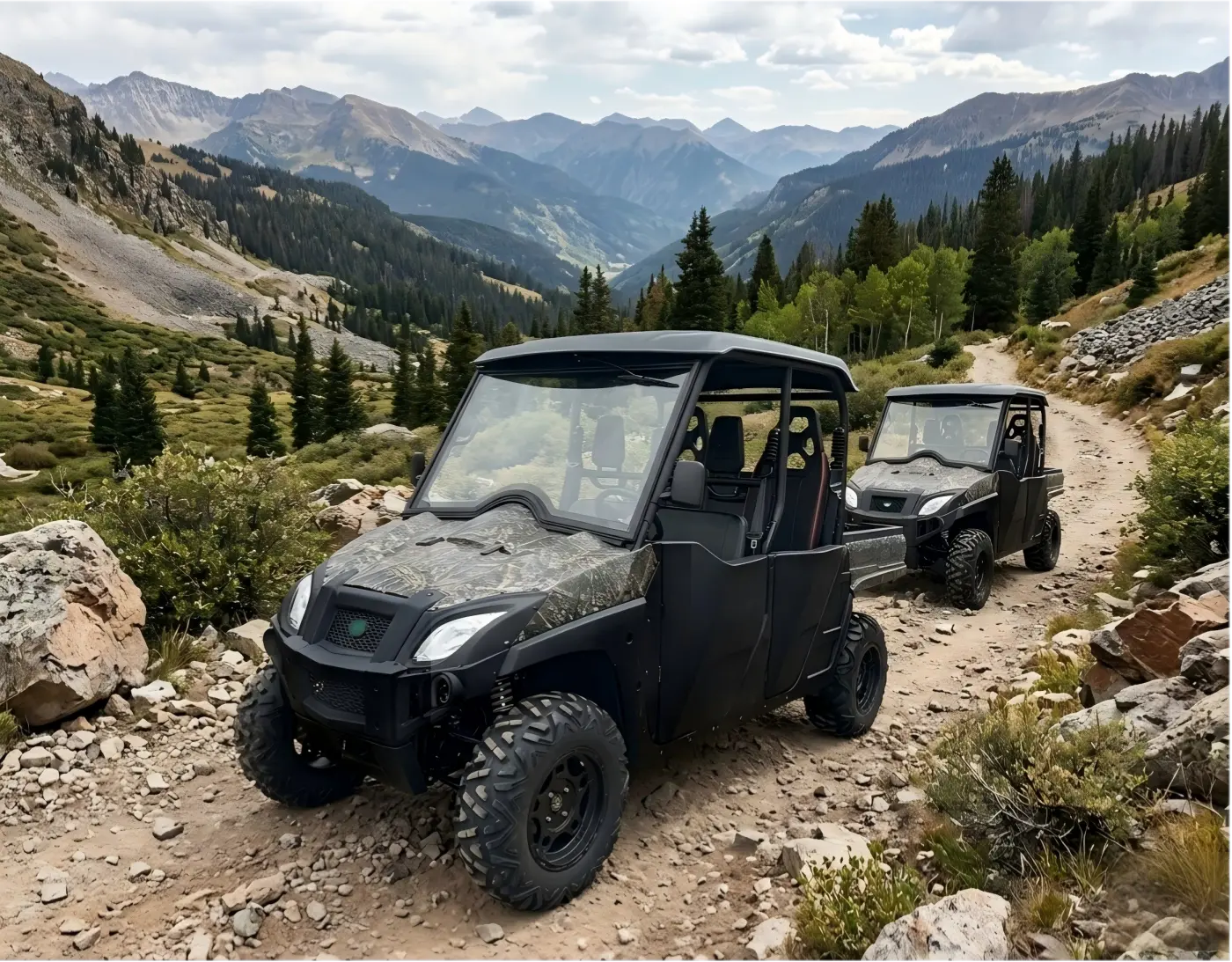
The thrill of conquering untamed terrain—be it a high-altitude mountain pass, a dense forest trail, or a sprawling agricultural landscape—is the driving force behind the global surge in Utility Terrain Vehicle (UTV) popularity. For modern operators, farmers, and adventure enthusiasts, the distinction between a reliable partner and a stranded vehicle often boils down to a single engineering factor: how the machine manages power in extreme environments. As shown in 02.webp, today’s top-tier UTV models are designed to navigate rugged, rocky, and uneven paths with precision and confidence.
This comprehensive guide explores the evolution of off-road mobility, focusing on the critical technologies that make modern Electric UTV platforms the gold standard for both industrial utility and recreational exploration.
Professional utility terrain vehicles maneuvering through challenging mountain terrain to test off-road mobility and drivetrain durability.
I. The Evolution of the All-Terrain Experience
The modern Utility Terrain Vehicle, or Side by side (SxS), has transcended its origins as a mere farm utility tool. Today, it represents a sophisticated fusion of automotive engineering and specialized off-road capability. Whether utilized for professional forestry patrols, large-scale agricultural management, or high-octane weekend trail riding, the demands placed on these vehicles have never been higher.
As illustrated in 02.webp, the ability to traverse steep, debris-strewn mountain paths with multiple passengers requires more than just raw horsepower; it demands a synergy of advanced suspension systems, high-torque drivetrains, and intuitive handling dynamics.
Key Drivers of Current UTV Demand:
Versatility: The ability to switch seamlessly between heavy-duty work and weekend adventure is paramount.
Technological Integration: From electronic power steering (EPS) to smart differential management, technology is enhancing safety and capability.
Durability in Harsh Environments: As seen in 02.webp, vehicles must withstand constant exposure to gravel, rocks, and unpredictable weather conditions.
II. Anatomy of a Trail-Ready UTV: Critical Components
To achieve the level of Off-road performance seen in 02.webp, a vehicle must be engineered with specific core attributes that prioritize stability, traction, and control.
1. Advanced Suspension Systems The rugged terrain depicted in 02.webp highlights the importance of independent suspension. Dual A-arm setups with long-travel shock absorbers allow each wheel to move independently, ensuring that the tires maintain contact with the ground even when navigating deep ruts or boulders. This stability is essential for preventing roll-overs and maintaining passenger comfort on long, grueling patrols.
2. High-Torque Drivetrains The transition from traditional internal combustion engines to high-capacity lithium-ion battery powertrains is revolutionizing the industry. Electric motors provide instant, maximum torque at low RPMs, which is critical when climbing steep, rocky grades or crawling over technical obstacles. This ensures consistent power delivery without the lag typically associated with traditional transmissions.
3. All-Terrain Tire Technology The tires shown in 02.webp are specifically designed for durability and grip. These tires feature aggressive tread patterns that provide lateral stability on loose gravel while offering the puncture resistance necessary for long-term use in forestry and agricultural settings.
III. The Strategic Advantage of Professional Fleet Management
For commercial operators, UTVs are not just vehicles; they are productive assets. Investing in a fleet that can reliably perform in environments like those shown in 02.webp provides a competitive edge.
Efficiency and Downtime Mitigation A vehicle that gets stuck requires expensive retrieval operations and causes significant downtime. By selecting platforms that prioritize traction-to-weight efficiency and robust chassis design, fleet managers can ensure that daily operations—such as fence inspection, timber management, or eco-tourism guiding—continue regardless of the terrain conditions.
The Role of Smart Technology Modern 4WD UTV platforms increasingly feature telematics that allow fleet managers to monitor vehicle health, location, and usage patterns in real-time. This predictive maintenance approach extends the working lifespan of the chassis and reduces total cost of ownership (TCO), making it a sound financial decision for any industrial enterprise.
Professional utility terrain vehicles utilizing high-torque drivetrains to navigate technical mountain terrain efficiently.
IV. Navigating the Future: Electric vs. Traditional Power
The industry is currently at a crossroads, balancing the proven reliability of traditional engines with the quiet, high-efficiency benefits of electric platforms.
Why Electric is Gaining Traction:
Environmental Compatibility: Quiet operation is essential for eco-patrols and wildlife observation, areas where traditional engine noise would be disruptive.
Instant Power: As previously mentioned, the torque profile of an electric motor is perfectly suited for the demands of technical off-road driving.
Maintenance: Electric vehicles have fewer moving parts, which translates to fewer oil changes, belt replacements, and general mechanical fatigue over time.
V. Operator Best Practices for Technical Terrain
As seen in 02.webp, even the most capable All-terrain vehicle requires skilled operation to navigate high-altitude or broken terrain safely.
1.Preparation: Always perform a pre-ride inspection of the tire pressure, battery levels, and suspension settings before heading into the backcountry.
2.Momentum Management: In rocky or loose terrain, maintain a steady pace. Sudden acceleration can cause tire spin, leading to loss of traction and potential environmental damage to the trail.
3.Load Distribution: When carrying cargo in the UTV’s bed, ensure the weight is balanced. An unevenly loaded vehicle will significantly alter the center of gravity, making it prone to instability on side-slopes.
A trail-ready electric UTV equipped for high-altitude environments, showcasing structural durability and off-road mobility.
VI. Conclusion: Defining the New Standard
The image captured in 02.webp serves as a perfect testament to the modern UTV’s role: an indispensable tool for accessing the most challenging corners of our world. As engineering continues to evolve, the focus will remain on enhancing the rider’s ability to interface with the environment safely and efficiently.
For the farmer, the forester, or the weekend enthusiast, the ideal vehicle is one that provides a seamless, powerful, and secure experience—no matter how rough the road ahead may be. By understanding the mechanical capabilities and operational nuances of these machines, operators can truly master the wild.
Frequently Asked Questions (FAQ)
Q: What is the most important feature for mountain UTV operation? A: While power is necessary, ground clearance and a quality independent suspension system are the most critical features for safely navigating rocky mountain passes.
Q: How does a UTV differ from an ATV in technical terrain? A: A UTV offers a lower center of gravity and a wider wheelbase, which typically provides superior stability and cargo capacity, making it safer for industrial or multi-passenger use.
Q: Is electric power reliable for remote, all-day operations? A: Modern lithium-battery technology offers significant range, and with proper route planning and charging infrastructure, electric UTVs are highly reliable for full-day commercial patrols.