The Ultimate Guide to UTV Differential Locks: Mastering Mud and 4WD Traction
Introduction: The Unseen Hero of All-Terrain Mobility
For operators of modern Utility Terrain Vehicles (UTVs) and Side by sides (SxS), the true test of a vehicle doesn’t happen on smooth, paved factory floors or dry exhibition tracks. It happens deep in the field—where a sudden rainstorm turns a farm track into a clay quagmire, or where a routine forestry patrol forces the vehicle over slick tree roots, rocky creek beds, and deep, unpredictable potholes.
In these extreme environments, having a powerful engine or a high-capacity lithium-battery powertrain is only half the battle. If that power cannot be effectively transferred to the ground, your high-end vehicle is nothing more than a multi-thousand-dollar paperweight spinning its wheels in the mud.
When navigating muddy, slippery, and potholed roads—the exact environments where a UTV is most likely to get stuck—the differential lock (diff lock) is often the single most critical chassis component that determines whether the vehicle can successfully escape entrapment under its own power or require an expensive, time-consuming winch-and-trailer rescue.
This comprehensive guide delivers a deep dive into the mechanical physics, practical applications, and strategic advantages of differential locks in modern 4WD UTVs. Whether you are managing an agricultural fleet, supervising an industrial eco-patrol, or engineering next-generation electric utility vehicles, understanding this drivetrain technology is essential to unlocking ultimate off-road trafficability.
I. Demystifying the Drivetrain: What is a Differential Lock?
To truly appreciate the engineering advantages of a differential lock, one must first understand the problem it was originally invented to solve: the mechanics of turning.
The Physics of the Open Differential
When a conventional Utility Terrain Vehicle executes a turn, the wheel on the outside of the turn must travel a longer physical distance than the wheel on the inside of the turn. Because the outer wheel covers more ground in the exact same amount of time, it must rotate at a faster speed than the inner wheel.
To allow this speed variance without snapping the drive axles, automotive engineers utilize a component called an open differential. An open differential uses a complex system of planetary gears to split the engine or motor torque while allowing the left and right wheels to rotate independently at different RPMs.
The Fatal Flaw of Open Differentials in Off-Road Scenarios
While an open differential works perfectly on high-traction paved roads, it possesses a severe, inherent mechanical limitation when taken off-road onto muddy, sandy, or slippery terrain.
By design, an open differential always sends an equal amount of torque to both wheels. Crucially, the maximum torque the differential can supply is limited by the wheel with the least amount of traction.
If one wheel of your UTV loses traction—for instance, if it drops into a slick mud pit or lifts completely off the ground over a deep pothole—the resistance on that wheel drops to near zero. Consequently:
Most of the engine or electric motor power is directed down the path of least resistance.
This causes the loose, tractionless tire to spin idly and frantically at high speeds.
Meanwhile, the opposite tire, which still maintains excellent grip on solid ground, receives almost no torque at all, leaving the vehicle completely immobilized.
Enter the Differential Lock: Mechanical Solidification
This is precisely where the function of the differential lock comes into play. A differential lock is a mechanical, pneumatic, or electromagnetic mechanism that temporarily bypasses the differential’s ability to allow different wheel speeds.
Once the operator engages the differential lock, it mechanically “locks” the left and right drive axles together into a single, unyielding shaft. This forces both wheels to rotate at the exact same rotational speed (RPM), regardless of the traction differences beneath them.
By engaging the diff lock, the mechanical link ensures that engine torque is transmitted to both wheels simultaneously. Even if one wheel is completely buried in a deep mud pit or suspended mid-air over a rut, the opposite wheel on solid ground continues to receive a guaranteed 50% of the available drivetrain torque, generating the precise traction force needed to pull the UTV out of entrapment.
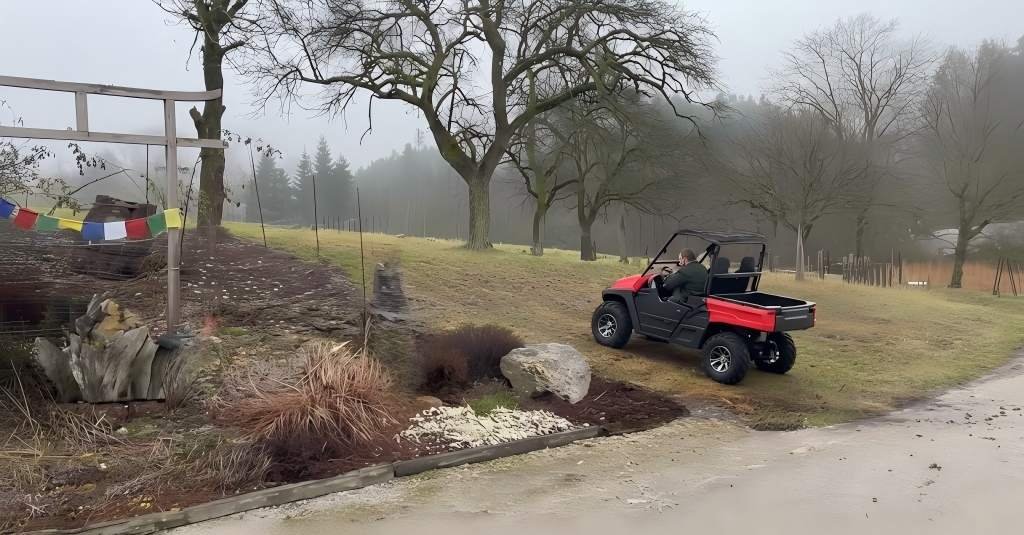
Farms and ranches often feature slippery, post-rain muddy terrain where advanced 4WD systems and differential locks keep utility vehicles moving safely.
II. The Anatomy of Trapping: Why Do UTV Buggies Get Stuck on Muddy Roads?
In professional industrial or agricultural fields, many operators are baffled when a heavy-duty side-by-side buggy with a seemingly high-horsepower engine or high-torque electric motor becomes completely stranded on a mild incline. The reality is simple: raw power means nothing without effective distribution. Without a differential lock, a 50-horsepower vehicle effectively becomes a zero-horsepower vehicle the moment a single tire begins to idle frantically in a slick spot.
III. Practical Functions of the Differential Lock in Muddy Terrain
When operating a high-performance UTV in rugged environments, engaging the differential lock alters the vehicle’s capability profile from a utility transport to an unstoppable terrain-conquering tool. Its practical benefits can be broken down into four core operational areas:
1. Absolute Elimination of Single-Wheel Idling
The primary mechanical victory of a differential lock is the immediate cessation of unilateral wheel spin. When a vehicle enters a mud pit with an open differential, the spinning wheel rapidly excavates the mud beneath it, burying the axle and high-centering the chassis. By locking the differential before or immediately during entry, power is evenly shared, ensuring that the gripping tire steps the vehicle forward before the loose tire can dig a deeper grave.
2. Maximizing Instantaneous Low-End Torque
In modern lithium-battery electric UTVs, electric motors deliver maximum torque starting at 0 RPM. If this massive surge of instant torque hits an open differential on a slippery road, it will instantly break the traction of the weaker tire.
Pairing a high-performance electric drivetrain with a locked differential ensures that this instant torque is perfectly bisected between both wheels. This smooth, highly controlled distribution maximizes the “static friction” threshold of both tires, allowing the vehicle to walk smoothly out of deep mud without aggressive, destructive tire spinning.
In heavy agricultural, industrial, and forestry settings, vehicles frequently travel through deep mud, wet grasslands, unpaved farm roads, and dense forest trails. The differential lock provides an immediate upgrade to the UTV’s operational envelope by:
Enhancing Net Traction Force: Utilizing the combined surface friction of all available wheels.Improving Trafficability: Allowing continuous forward momentum over highly irregular ground.
Reducing Extrapment Probability: Minimizing the operational risks associated with solo field missions.
Decreasing Trailer Rescue Dependencies: Saving organizations thousands of dollars in lost productivity, vehicle downtime, and secondary retrieval machinery costs.
Industry Note: This advantage of the mechanical differential lock is particularly prominent for heavy-duty UTVs carrying maxed-out payloads of tools, liquids, or materials, where the high rear-axle weight makes getting stuck an incredibly labor-intensive issue to resolve.
Typical Application Scenarios: Where the Diff Lock Proves Its Worth
The necessity of the differential lock spans a wide array of professional and commercial sectors. Below are the primary environments where engaging the differential lock shifts from an optional tactic to an operational requirement.
1. Farms, Agriculture, and Ranches
Agricultural operations never pause for the weather. Side by side buggies are routinely tasked with transporting heavy tools, livestock feed, fencing equipment, or water tanks over vast pastures right after torrential downpours.
The Challenge: Wet grass over saturated soil behaves like ice, and fully loaded utility beds drastically alter the vehicle’s center of gravity.
The Diff Lock Solution: When traversing muddy gates, tilled fields, or soft creek crossings, a locked differential guarantees that the tires can biting through the topsoil to find solid purchase, moving equipment stably without tearing up valuable turf via unnecessary tire spinning.
2. Mountain Patrolling and Dense Forest Roads
Forestry management, power grid maintenance, and border patrol operations frequently occur on steep, unpaved mountain tracks characterized by a chaotic mix of deep mud, slick fallen leaves, exposed tree roots, and loose, unstable stones.
The Challenge: As a UTV climbs a rocky, uneven grade, the suspension flexes heavily. This often leaves one tire lightly weighted or completely off the ground as the chassis moves over boulders or washouts.
The Diff Lock Solution: With uneven tire adhesion across the axle, an off-road vehicle with a locked differential maintains a highly stable, predictable climbing trajectory. The suspended wheel doesn’t rob power; instead, the wheel firmly planted on the mountain rock continues to push the UTV upward safely.
3. Desert Sand Dunes and Snowy Winter Terrain
Extreme environments extend far beyond traditional mud. Loose desert sand and deep winter snowpack share an identical mechanical problem with mud: extremely low ground adhesion.
The Challenge: In loose sand or deep snow, once a tire begins to spin idly, it immediately creates a pocket, causing the vehicle to bottom out on its skid plates within seconds.
The Diff Lock Solution: Engaging the front or rear diff locks allows the tires to float and drive simultaneously, spreading the load evenly to maintain critical forward velocity, which is the golden rule for navigating sandy or snowy landscapes.
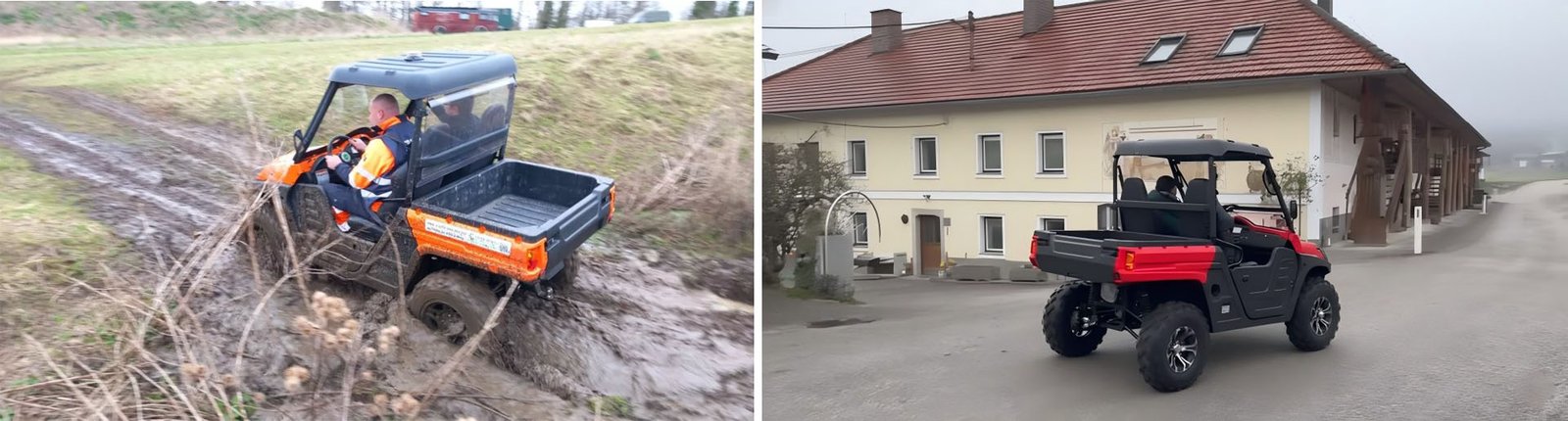
Muddy, slippery, and potholed roads are where conventional open differentials fail. Selectable differential locks ensure both wheels receive equal power to successfully escape entrapment.
V. Operator’s Manual: Critical Safety Notes on Differential Lock Usage
While a differential lock is an incredibly potent tool for extreme traction generation, its mechanical rigidity means it must be treated with respect. Mishandling a differential lock can result in severe mechanical failure or unsafe vehicle handling. Operators must strictly adhere to the following parameters:
1. The Danger of Paved Roads and High-Traction Surfaces
Never leave a differential lock engaged when driving on conventional paved roads, concrete, or dry, hard-packed earth. Because a locked differential forces the left and right wheels to turn at the exact same speed, when the UTV attempts to turn on a high-traction surface:
The inner tire will violently hop, chirp, and bind because it cannot slip naturally to match the turning radius.
This binding action introduces extreme, destructive torsional stress directly into the drive axles, CV joints, and the differential casing itself.
Over time, this leads to catastrophic drivetrain snapping, sheared gear teeth, and highly accelerated tire tread wear.
2. Radical Alterations to Steering Dynamics
When a front differential lock is fully engaged, steering steering effort increases exponentially. Because both front tires are forced to turn at identical speeds, the vehicle will naturally want to drive in a straight line. Turning the steering wheel becomes significantly harder, and the vehicle’s turning radius is dramatically widened. Operators must anticipate this resistance and adjust their speed accordingly.
3. The Definitive Usage Protocol
Best Practices for Diff Lock Operation
Analyze the Road Ahead: Always engage the differential lock before entering a known hazard (like a visible deep mud pit, a steep sandy incline, or a slick river crossing). Prevention is far more effective than trying to escape after sinking.
Stop or Slow Down to Engage: Never flip the differential lock switch while the wheels are spinning frantically at high RPMs. Engaging the lock during high-speed wheel spin will slam the locking pins into place with immense force, instantly shattering internal differential gears. Stop the vehicle completely or drop to a crawl before engagement.
Disengage Promptly: The absolute moment the UTV has cleared the low-adhesion mud pit, sand dune, or snow patch and returned to a stable, high-traction surface, disengage the differential lock immediately to relieve drivetrain stress.
Avoid High-Speed Operation: Keep speeds low and controlled while the differential lock is active. High-speed cornering with a locked axle can result in a sudden loss of control or unexpected vehicle rollovers.
Navigating hidden potholes and slick stones in creek beds requires more than raw horsepower; it demands continuous, effective traction force distributed to all wheels.
VI. B2B Industry Insight: Why High-End UTVs Attach Extreme Importance to Advanced Differential Configurations
In the commercial procurement landscape—encompassing industrial eco-tourism, professional farming, large-scale forestry, and commercial estate patrol—smart buyers look far beyond pure engine horsepower or basic aesthetics. They evaluate a vehicle’s Traction-to-Weight Efficiency.
For demanding field operations, a buggy requires not just raw rotational energy, but more importantly, “effective, usable traction force.” This distinction is why premium, high-performance UTVs utilize highly advanced, multi-tiered drivetrain architectures.
The Ultimate Drivetrain Configuration Matrix
To achieve maximum operational up-time in the harshest environments on earth, elite industrial UTVs are typically engineered with a combination of the following four critical powertrain configurations:
Selectable Four-Wheel Drive (4WD System): Distributes primary power between the front and rear axles, doubling the vehicle’s initial operational grip footprint.
Independent Rear Differential Lock: The primary line of defense. Since the rear bed carries the payload weight, locking the rear axle maximizes the UTV’s primary pushing power over soft terrain.
Independent Front Differential Lock: The ultimate escape mechanism. When both the rear wheels and one front wheel are completely compromised, locking the front differential ensures that the final remaining front tire can pull the entire weight of the vehicle out of a deep trench.
Low-Speed High-Torque Mode (Low Gear / Work Mode): Alters the internal gear ratios to deliver maximum mechanical advantage to the wheels, multiplying the torque while keeping wheel speeds low and highly controlled to prevent spinning out.
The Shift Toward Smart Electronic Locking Differentials
As the global market transitions toward green energy solutions, premium electric UTV manufacturers are taking traction control a step further by integrating Smart Electronic Differential Locks (e-Locks) or automated slip-detection systems.
These high-end electronic systems utilize speed sensors on each wheel to monitor traction levels hundreds of times per second. The moment the central processing unit detects micro-slippage on a single wheel, it instantly engages electromagnetic locking mechanisms or applies precise independent wheel braking to route electric torque to the wheels with grip. This occurs automatically, without requiring manual operator intervention.
For fleet managers and commercial buyers, investing in high-end UTV platforms equipped with comprehensive front and rear differential locks represents an invaluable asset for long-term risk mitigation. A vehicle that can effortlessly walk away from deep mud pits, slippery hillsides, and washed-out ranch tracks keeps operations moving smoothly, protects workers from becoming stranded in remote areas, and dramatically extends the overall working lifespan of the vehicle’s chassis and transmission components.
VII. Conclusion: The New Benchmark for All-Terrain Performance
As outdoor operations and commercial land management face stricter demands for efficiency, safety, and environmental compatibility, the engineering of the all-terrain vehicle continues to evolve at a breakneck pace. The modern combination of high-capacity lithium-ion batteries and silent electric motors has successfully solved the historical challenges of emissions, fuel costs, and loud operational noise.
However, no matter how clean or quiet a vehicle’s power source is, it must always respect the unyielding laws of physical mechanical traction.
The integration of robust, highly articulate Dual A-Arm independent suspensions with precise, heavy-duty front and rear selectable differential locks represents the modern gold standard for utility vehicle engineering. Together, these systems guarantee that every ounce of generated torque is perfectly converted into reliable, smooth, forward momentum—allowing modern UTV buggies to dominate the absolute toughest terrains on earth while providing an unparalleled level of safety, comfort, and long-term cost-effectiveness for operators worldwide.