
Dilemma of traditional agriculture and new opportunities for electric agricultural machinery
Modern agriculture is facing all-round operation pressure, and countless farmers are trapped in the development dilemma of difficult income increase, high cost and tedious operation. The continuous fluctuation and rise of fuel price, increasingly strict environmental protection supervision policy, serious shortage of rural labor force, low efficiency of traditional agricultural transportation equipment and superposition of multiple problems have greatly reduced the profit space of farms and restricted the large-scale and standardized development of agriculture.
Under the background of this industry, smart agriculture and green agriculture have become the core trend of global agricultural development. More and more farms began to abandon the old and energy-consuming traditional equipment and turned to low-cost, high-efficiency and zero-pollution intelligent agricultural machinery equipment to complete the iterative upgrading of agricultural production mode.
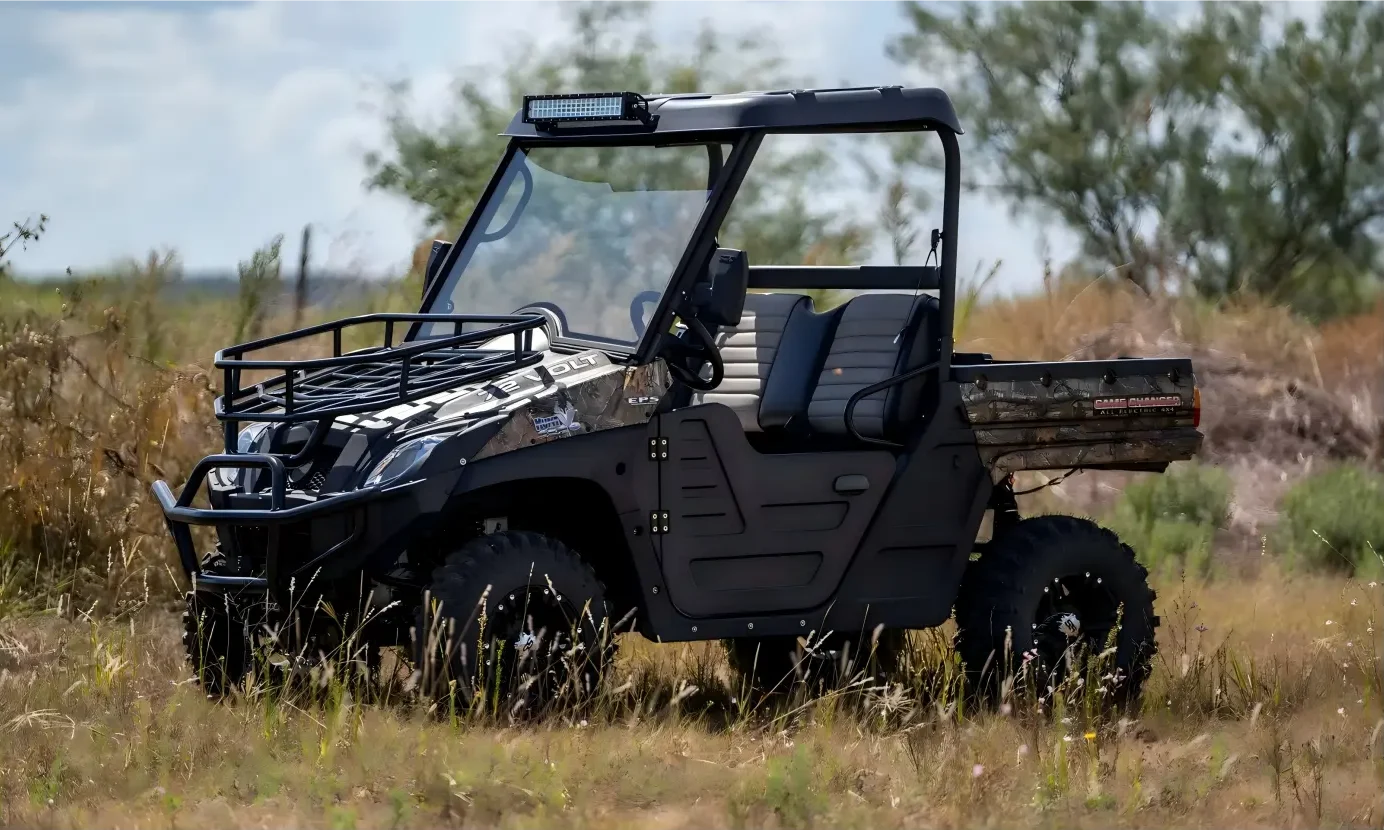
Among them, the four-wheel drive electric UTV off-road vehicle completely breaks the limitation of traditional agricultural equipment by virtue of its all-round off-road performance, extremely low operating cost and diversified adaptability. It is no longer a small crowd of auxiliary agricultural machinery, but a subversive tool to reshape modern agricultural operation mode and promote farm cost reduction and efficiency increase, becoming the core reform tool for future agricultural development.
This paper will deeply analyze the core pain points of modern agriculture, comprehensively disassemble the product advantages, landing scenes, comparative advantages and future trends of 4WD electric UTV, help farm operators clearly understand the core value of this equipment and accurately grasp the opportunities for agricultural electrification transformation.
The core development dilemma of modern agriculture (industry pain point 2025-2026)
According to the latest industry report of U.S. Department of Agriculture, Farm Bureau and OECD, from 2025 to 2026, the global modern agriculture faces multiple pressures from four dimensions of economy, environment, manpower and market, and large and small farms encounter different degrees of operation problems, and the disadvantages of traditional production mode are completely highlighted.
2.1 The cost income and expenditure are unbalanced, and the profit space continues to be compressed
Modern agriculture has fallen into a serious cost-price squeeze dilemma, and the cost of production inputs such as fertilizer, seeds, agricultural machinery, manpower and land rent continues to rise, reaching a new high in recent years. However, agricultural commodity prices fluctuate violently, most grains, fruits and vegetables, animal husbandry products sell below the break-even point, farm revenue is extremely unstable.
The long-term imbalance of income and expenditure has led to the continuous decline of net income of global farms, the sharp rise of farm debt ratio and the increase of agricultural bankruptcy cases year by year. Small and medium-sized farms are weak in anti-risk ability and face survival crisis, and the trend of large-scale integration of the industry becomes more and more obvious. The high fuel costs and maintenance costs of traditional oil-fired agricultural machinery further aggravate the operating burden of the farm.
2.2 Climate and environmental pressure, production risk
The extreme weather caused by global climate change has become the biggest uncertainty factor in modern agriculture. Frequent disasters such as drought, flood, high temperature storm and continuous rainfall will not only directly cause crop reduction and damage to farmland infrastructure, but also induce the breeding of diseases and insect pests, greatly increasing the risk of agricultural production.
At the same time, the global carbon neutralization policy has been fully implemented, and the environmental protection control in the agricultural field is becoming increasingly strict. Traditional oil-fired agricultural machinery exhaust emission, fuel leakage pollution and other problems do not meet the development standards of green agriculture and ecological agriculture, many suburban farms and ecological farms face the problems of equipment rectification and production limitation.
2.3 Labor shortage, labor efficiency is difficult to improve
The aging of the rural population is serious, the outflow of young labor force is large, and the shortage of skilled agricultural workers and seasonal employees continues. Superimposed visa policy, rising labor costs and other factors, farm recruitment difficult, expensive labor become the norm.
The labor cost rises year by year, which not only directly increases the farm operation expenditure, but also leads to the lag of basic work such as field patrol, material transportation, equipment maintenance, etc. due to insufficient manpower, which delays farming season, reduces production efficiency and seriously restricts the large-scale development of farms.
2.4 Traditional equipment has prominent limitations and insufficient adaptability
Traditional oil-fired agricultural vehicles and small agricultural machinery have poor terrain adaptability. Facing the complex terrain such as muddy farmland, steep slope mountain, gravel earth road, wet and waterlogged farmland, the problems of slipping, sinking and insufficient power are easy to occur, which cannot meet the operation requirements of mountainous orchards, large-scale pastures and hilly farmland.
In addition, the operation noise and vibration of fuel equipment not only affect the working experience of operators, but also disturb livestock and poultry and interfere with the growth of crops. It is completely unable to meet the needs of refined and ecological modern agricultural production. The old equipment has single function and poor universality, which further restricts the improvement of farm production efficiency.

What is a four-wheel drive electric UTV SUV? Core definitions and product characteristics
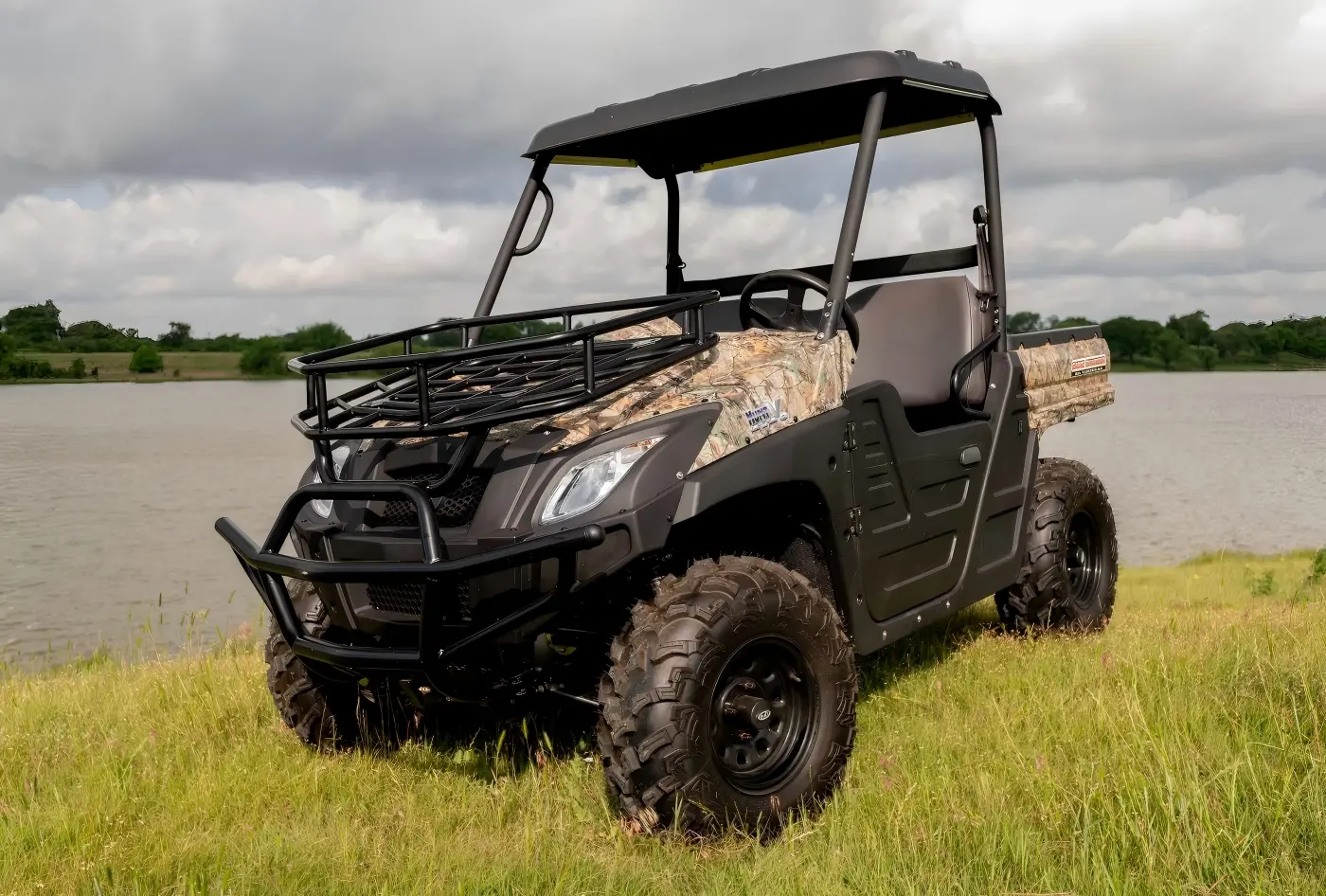
Four-wheel drive electric UTV off-road vehicle, full name Electric Utility Task Vehicle, is a battery-powered side-by-side multi-functional operation vehicle specially developed for complex outdoor and agricultural scenes. Different from traditional fuel-fired UTV, ATV and agricultural trucks, it is equipped with pure electric power system and professional four-wheel drive system, giving consideration to off-road performance, loading capacity and environmental protection attributes. It is a new intelligent agricultural machinery suitable for full-scene agricultural operation.
The vehicle supports intelligent switching between fixed 4WD or 2WD/4WD, abandons the traditional fuel engine, and relies on lithium battery pack to drive the motor to run. It can meet the needs of agricultural operation, pasture management, orchard operation and maintenance, land management and maintenance, outdoor operation and other scenarios, and has the core advantages of zero emission, low noise and instantaneous high torque.
3.1 Core power and hardware configuration
The mainstream of 4WD electric UTV is equipped with high-rate lithium battery pack and permanent magnet synchronous motor, with stable and strong power output. Compared with the fuel engine, the electric power structure has fewer parts and more stable operation, and the problems of engine vibration and excessive noise are eliminated.
The equipment can output peak torque at the beginning, with excellent climbing, dragging and loading capacity, which perfectly meets the operation requirements of farmland steep slope and muddy road surface. The whole vehicle supports intelligent power regulation and control, and can automatically adjust power output according to terrain and load, giving consideration to the balance of power and energy consumption.
3.2 Professional 4WD off-road performance
The four-wheel drive system specially built for agricultural complex terrain is equipped with electronic differential lock and high-low speed gear adjustment function, which is suitable for all kinds of extreme farmland road conditions. The ground clearance of the whole vehicle can reach more than 170-220mm, and it is equipped with independent suspension system and all-terrain off-road tires for strong trafficability.
The vehicle can easily cope with complex terrains such as steep slopes of 20 – 30 degrees, muddy depressions, gravel dirt roads, soft farmlands and the like, and the problems of vehicle sinking and slipping are eliminated; and the vehicle can stably operate in wet and waterlogged farmlands in rainy seasons or snow-covered fields in winter, and is suitable for outdoor work of farms in all weather.
3.3 Practical design for farming
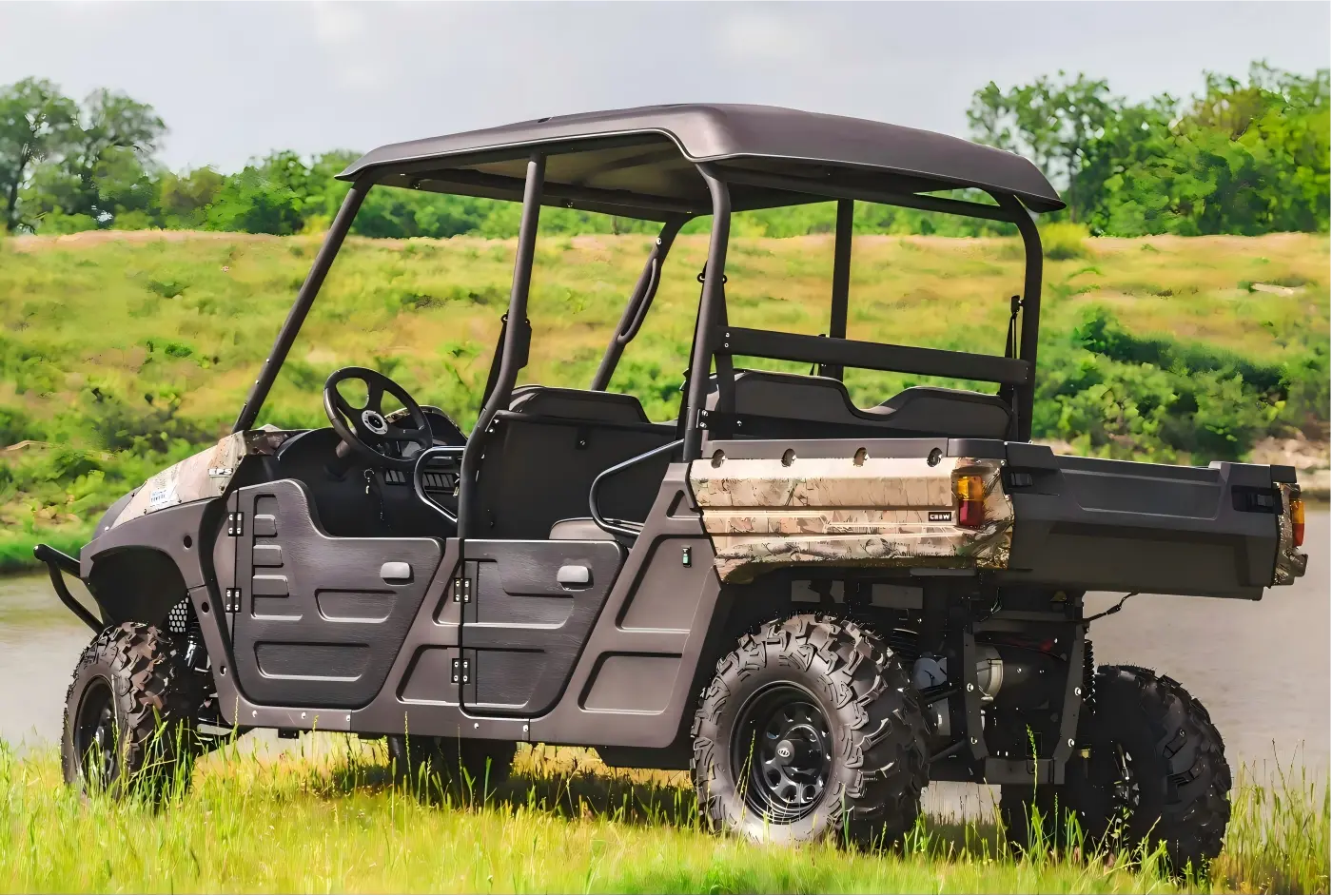
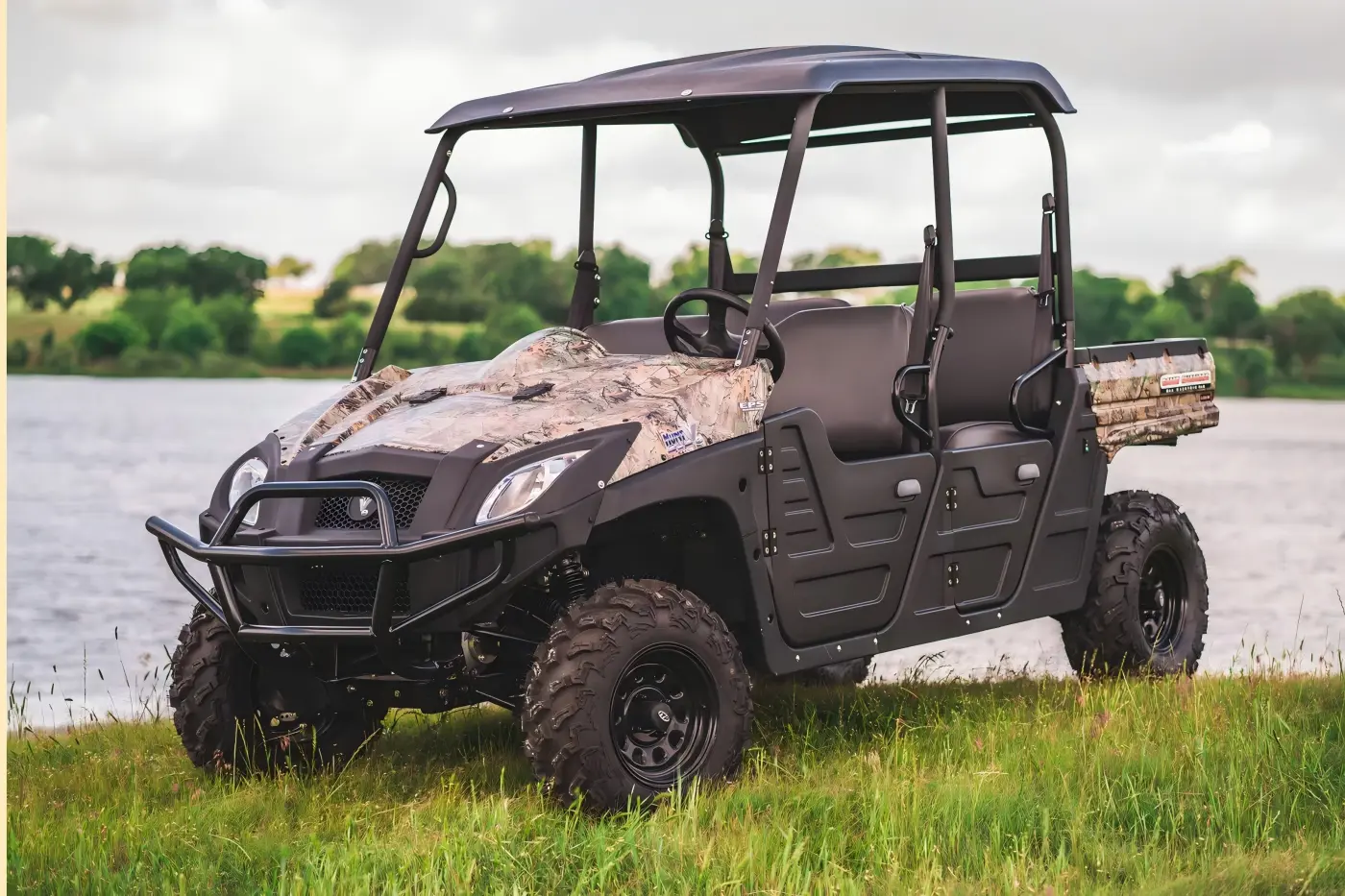
The vehicle adopts agricultural exclusive multifunctional design and is equipped with 2-6 seats side by side to meet the needs of multi-person field operation, farm patrol and personnel transfer. The rear self-unloading bucket supports manual/electric unloading, and can easily load seeds, fertilizers, feed, farm implements, fruits and vegetables and other agricultural materials.
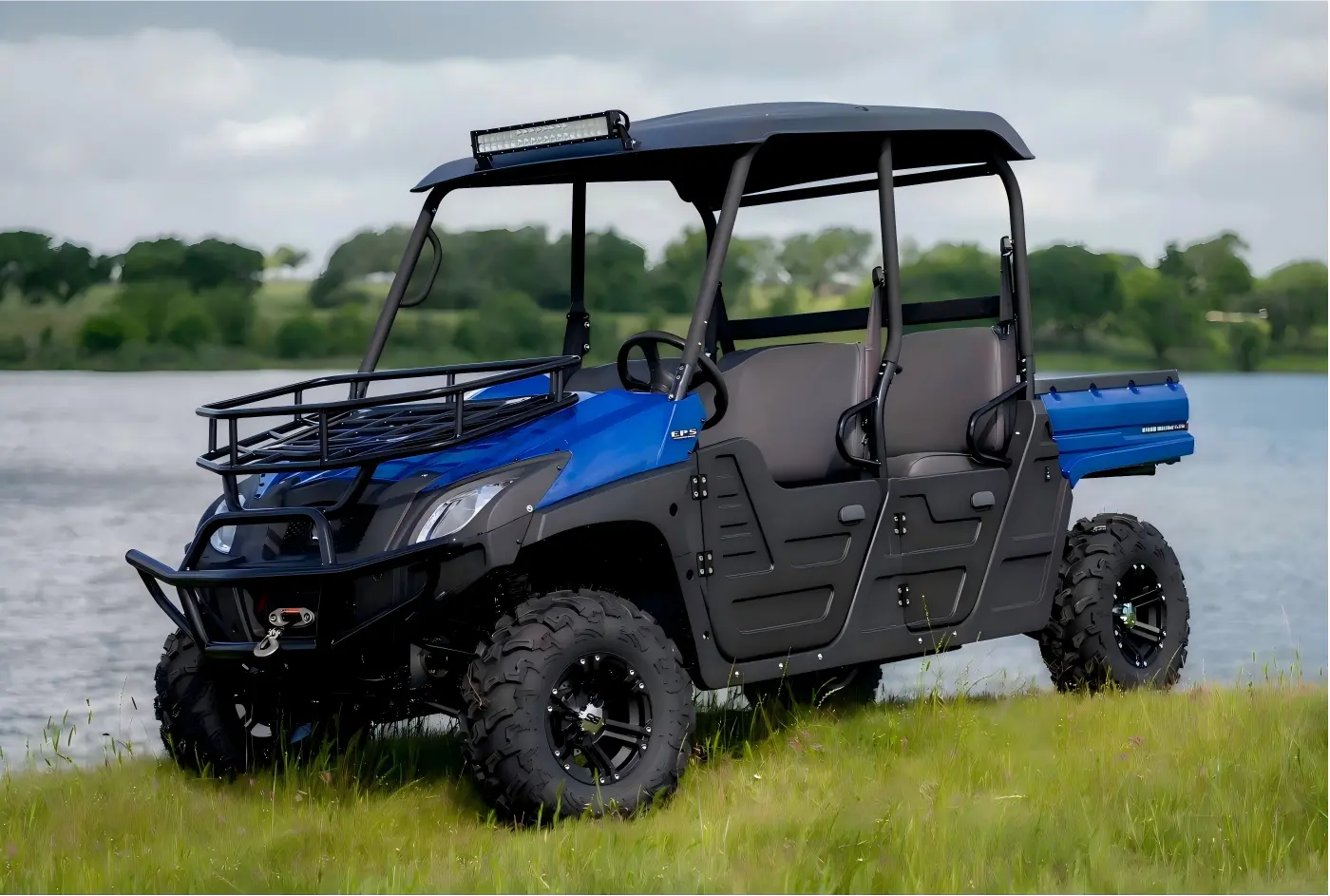
The whole series is equipped with professional dragging interface, with a dragging bearing capacity of 1000-2500 pounds. It can be matched with various agricultural accessories such as sprayer, fertilizer spreader, winch, mower, etc. to realize multi-purpose of one machine. Some high-equipped models support the installation of enclosed cab and windproof and rainproof facilities, which is suitable for all-weather operation all year round.
3.4 Core performance parameters (mainstream agricultural models)
In terms of speed, the agricultural model can reach 25-60 miles per hour, and the operation model focuses on stable low-speed power output, which is both safe and practical. Excellent battery life, 40-100 miles on a single full charge, for most farm day-to-day operations.
The power coverage is wide, and the power of basic operation fund is 5-15kW, which is enough to cope with conventional farmland operation and maintenance work; the power of high-end model can be comparable to that of fuel equipment, which is suitable for heavy load, dragging and high-intensity off-road operation. Flexible charging mode, supporting household conventional socket charging, high-equipped models compatible with fast charging mode, suitable for diversified farm power consumption scenarios.
The four-wheel drive electric UTV subverts the eight core advantages of modern agriculture
4.1 Minimize costs and significantly reduce long-term farm operating expenses
Fuel costs are the biggest ongoing expense of traditional farm equipment, while the 4WD electric UTV is completely fuel-free and relies solely on electric power. Under the same operation intensity, the electricity cost is only 1/4-1/5 of the oil cost, and the long-term high-frequency operation can save huge energy consumption expenditure.
At the same time, the pure electric power structure is simple, there are no consumable parts such as spark plug, engine oil filter element, fuel pipeline, etc., and the high-frequency maintenance items such as engine oil replacement, oil path overhaul, engine maintenance, etc. are completely eliminated. The average annual maintenance cost is reduced by 50%-70% compared with that of fuel UTV, and the equipment maintenance cost and downtime are greatly reduced.
The service life of the motor is far longer than that of the fuel engine, the equipment failure rate is extremely low, the equipment maintenance cost and the replacement cost are effectively reduced, the equipment investment cost can be recovered through cost saving within 3-5 years, and the long-term cost performance is far superior to that of the traditional fuel agricultural machinery.
4.2 Four-wheel drive all-round off-road, suitable for all-terrain farmland operation
Modern agricultural operation scenes are complex and diverse, such as mountainous areas, hills, muddy farmland, sloping orchards and other terrains, which require extremely high equipment trafficability. Four-wheel drive electric UTV is equipped with intelligent four-wheel drive power distribution system. The four wheels exert force synchronously and the grip is balanced and stable.
In the face of the rainy season muddy soft arable land, rugged steep slopes, is full of gravel field road, the equipment can be smooth traffic, will not appear unilateral wheel slip, stuck car PaWo situation. The high ground clearance and independent suspension design can not only protect the chassis, but also reduce the rolling of farmland soil, which is suitable for fine agricultural operation.
Compared with the short board that the large tractor is heavy and cannot enter the narrow orchard row spacing, the electric UTV is compact and flexible, and can freely shuttle through orchards, vineyards and greenhouse bases, filling the market gap of small and fine agricultural equipment.
4.3 Zero pollution emission, helping to upgrade green ecological agriculture
Traditional oil-fired agricultural machinery will continuously discharge tail gas and produce pollutants such as carbon monoxide and hydrocarbon during operation, which not only pollutes farmland air, but also settles on soil and crop surface, affects the quality of agricultural products, and does not meet the certification standards of organic agriculture and ecological agriculture.
The four-wheel drive electric UTV realizes zero exhaust emission, no fuel leakage and no waste gas pollution during the whole operation process, which can effectively protect farmland soil, water source and surrounding ecological environment. For the farms focusing on green planting, organic fruits and vegetables and ecological breeding, they can easily pass various environmental protection certifications and green agriculture audits.
Under the general trend of global carbon neutralization and green transformation of agriculture, the use of electric agricultural machinery can help farms implement low-carbon production objectives, conform to policy guidance, and can also apply for green agricultural subsidies from various regions to further reduce operating costs.
4.4 Quiet and low-vibration operation, suitable for breeding and fine operation
Traditional fuel oil equipment has large operation noise and strong vibration, which not only affects the physical and mental health of operators, causes operation fatigue, but also seriously disturbs livestock and poultry populations, leads to livestock stress, milk yield reduction, poultry restlessness and affects breeding income.
The four-wheel drive electric UTV adopts quiet motor design, which has extremely low running noise and almost no mechanical vibration. During pasture inspection, feed transfer and livestock and poultry management and protection, livestock will not be disturbed, the breeding environment can be maintained stable, and the normal growth and breeding of livestock and poultry can be guaranteed.
At the same time, the mute feature supports all-weather operation in the morning, night and busy farming peak hours, without noise disturbing residents. It is suitable for special scenes such as suburban farms, ecological parks, residential agricultural complexes, etc., and the operation flexibility is greatly improved.
4.5 Instantaneous high torque, far more efficient than traditional equipment
The core advantage of electric power lies in zero speed peak torque output, which can output maximum traction force at the moment of starting, which is incomparable to fuel engine. In the operation of dragging agricultural machinery, climbing with heavy load and getting rid of difficulties in mud, the power response is faster and the output is more stable.
The fuel equipment needs to be preheated at idle speed and gradually increase the power, which not only takes a long time, but also has obvious power jam during low-speed operation. However, the electric UTV does not need to be preheated and can be started up for operation. The power output is linear and stable, and it is accurately adapted to refined low-speed operation scenarios such as fertilizing, spraying and patrol inspection.
The whole machine is sensitive in response and simple in operation. Novices and seasonal employees can quickly get started without professional operation skills, greatly reducing the manual operation threshold and effectively improving the overall operation efficiency of the farm.
4.6 One machine is multi-purpose, covering the agricultural operation demand of the whole scene
The four-wheel drive electric UTV has strong universality and can adapt to all kinds of agricultural scenes such as planting, breeding, management and maintenance, operation and maintenance, etc. One equipment can replace a variety of single-function agricultural machinery, reduce the purchase quantity of farm equipment and save the storage space of the site.
It can complete basic work such as agricultural materials transportation, field patrol, crop monitoring, fruit and vegetable harvesting and transportation on a daily basis. With accessories, it can realize multi-functional operations such as spraying, fertilizing, mowing, snow removal, fence maintenance, equipment dragging, etc., covering the daily operation and maintenance needs of the farm in an all-round way.
No matter small family farms, medium-sized fruit and vegetable bases, or large-scale pastures and mountain forest planting bases, they can rely on electric UTV to complete normal operation, and the equipment utilization rate is much higher than that of traditional special agricultural machinery.
4.7 the operation is comfortable and safe, and that burden of manual work is reduce
Abandon the disadvantages of high temperature, pungent tail gas and strong vibration of fuel equipment, no waste gas, no high-temperature baking and weak vibration during electric UTV operation, greatly improve the operating environment of operators and reduce fatigue caused by long-term operation.
The whole vehicle is equipped with anti-rolling protection device, safety belt, LED lighting, reversing image and other safety configurations, with strong body stability and higher safety in steep slope and muddy road sections. The high-definition digital instrument panel can display the electric quantity, mileage and power status in real time, and the running status of the equipment can be seen at a glance.
Some models support the installation of enclosed cab, warm air and sunshade facilities, which can resist wind, rain, scorching sun, low temperature and other inclement weather, and realize comfortable operation in spring, summer, autumn and winter.
4.8 Forward-looking layout, assist the future intelligent upgrading of the farm
Modern agriculture is accelerating the transformation to intellectualization, precision and electrification. As a pure electric intelligent device, electric UTV can seamlessly connect modern agricultural technologies such as GPS positioning, intelligent sensing, precision agriculture system, UAV linkage, etc.
The equipment can be equipped with intelligent monitoring module to realize the functions of field data collection, operation route planning, intelligent load monitoring, automatic fault early warning, etc., and assist the farm to realize fine and digital management.
With the iterative upgrading of battery technology and automatic driving technology, electric UTV can continuously adapt to the new intelligent agricultural system, avoid the problem of rapid elimination of traditional fuel equipment, help farms lay out intelligent agricultural tracks in advance, and enhance their core competitiveness.
Mainstream agricultural landing application scenario of 4WD electric UTV
5.1 Field planting base: efficiently complete field operation and maintenance and material transfer
In the large-scale field planting scenes such as corn, soybean and rice, the four-wheel drive electric UTV mainly undertakes daily field patrol, pest monitoring, soil sampling, agricultural materials transportation, etc. The compact and flexible body can move freely through the field ridges without crushing the crops.
In the harvest season, mature fruits, vegetables and grains can be quickly transported to replace manual short-distance transportation, and the harvest efficiency can be greatly improved. The farmland is muddy and slippery in rainy season. With the four-wheel drive off-road performance, the electric UTV can normally enter and leave the field for operation, solving the problem that traditional vehicles cannot go to the ground in rainy days.
5.2 Livestock and poultry breeding pasture: silent management and protection to ensure the healthy growth of livestock and poultry
Pasture breeding has extremely high requirements on noise and emission of operation equipment. The quiet and zero emission characteristics of four-wheel drive electric UTV perfectly match the pasture scene. Daily inspection of cattle, sheep and poultry population, epidemic disease screening, feed and grass transfer, drinking water equipment maintenance and other work can be completed.
The equipment has no noise and tail gas during operation, does not disturb livestock and poultry, and effectively avoids the problems of livestock stress production reduction, agitation injury and the like. The four-wheel drive off-road performance can easily deal with large area grassland, muddy pasture and slope grassland, and meet the management and maintenance needs of large-scale pasture in the whole region. At the same time, it can quickly respond to the emergency situation of the pasture, and complete the transfer of emergency materials, equipment emergency repair, etc.
5.3 Orchard and vineyard characteristic planting: fine adaptation to narrow row spacing operations
Orchard, vineyard, berry planting base row spacing narrow, dense plants, large agricultural machinery can not enter, manual labor efficiency is extremely low. The four-wheel drive electric UTV is small in size and flexible in steering. It can easily shuttle through narrow planting row spacing. It is the core auxiliary equipment for characteristic planting.
It can complete fine operations such as fruit tree pruning tool transfer, flower and fruit bagging assistance, pesticide spraying, fertilizer broadcasting, mature fruit harvesting and transfer, etc. The low-rolling body design protects the orchard soil structure and fruit tree roots, helping to plant high-quality fruits and vegetables.
5.4 Large-scale land and agriculture and forestry management and maintenance: efficient patrol operation and maintenance in the whole region
For large-scale farms, mountain forest bases and rural contiguous land, electric UTV can undertake global patrol inspection, fence maintenance, river irrigation facilities investigation, site cleaning, weed removal and other work. The long battery life can meet the requirements of all-day patrol inspection in large areas.
In winter, snow removal accessories can be used to complete snow removal operation on the site. In rainy season, hidden dangers of flood and waterlogging can be checked. Outdoor land management and maintenance work can be adapted all year round, greatly reducing manual inspection cost and improving management efficiency of large area of land.
Electric UTV VS Fuel UTV: All-round comparison and evaluation of farm scene
Many farmers struggle with the choice of electric UTV and traditional fuel UTV when shopping for equipment. Each of the two devices has its own advantages and is suitable for different farm operation scenarios. In combination with the needs of modern agricultural operations, we conduct all-round comparison from eight core dimensions to help the farm accurately select the type.
6.1 Operating cost: long-term cost-performance ratio of electric vehicle type wins
The early purchase price of electric UTV is slightly higher than that of fuel model, but the long-term operating cost advantage is extremely outstanding. No fuel consumption in the whole process, only low-cost electricity charge is needed, and the annual energy consumption expenditure can be saved by thousands to tens of thousands of yuan. At the same time, the simple power structure greatly reduces the cost of maintenance, repair and parts replacement.
Fuel UTV has lower procurement cost in the early stage, but the long-term continuous expenditure on fuel, oil, filter element and spark plug replacement is higher, and the dusty and humid environment of farmland will accelerate the engine loss, and the maintenance frequency is high and the cost is high. Combined with the 3 – 5 year full cycle cost, the total cost of electric UTV is much lower than that of fuel model.
6.2 Operating performance: each has its own emphasis, electric more suitable for daily farming
Electric UTV has zero speed instantaneous high torque, strong low-speed dragging, climbing and getting out of difficulty ability, stable and delicate power output, accurate adaptation to daily agricultural scenes such as spraying, patrol inspection, fine transportation, etc., high operation fault tolerance rate and easy for beginners to use.
The advantages of fuel UTV are concentrated in continuous high-speed and heavy-load operation, long-term high-intensity dragging, more sufficient power reserve for long-distance driving, fast and convenient refueling and no battery life anxiety, which is more suitable for large-scale field and long-time continuous operation scenarios.
6.3 Environment and operation experience: electric vehicles are fully dominant
Electric UTV has zero exhaust gas, zero pollution, low noise, low vibration, comfortable operating environment, no disturbance to residents, no disturbance to livestock and poultry, suitable for sensitive scenes such as ecological farms, suburban farms, breeding bases, etc., and unlimited all-weather operation.
The fuel UTV operation has large noise, pungent tail gas and strong vibration, which not only affects the health of operators, but also interferes with the growth of livestock and poultry and pollutes the farmland environment. The operation in the early morning and at night is easy to cause noise disturbing the residents, and the scene adaptability is limited.
6.4 Endurance and replenishment: fuel replenishment is convenient, and electric power is continuously upgraded
The fuel UTV can be refueled at any time and can be replenished in a few minutes. The battery life is unlimited. It is suitable for remote large farms and operation scenarios without fixed charging sites. It is more flexible for extreme high-intensity operation.
The electric UTV has a battery life of 40 – 100 miles on a single charge, which is enough to meet the daily needs of most small and medium-sized farms. With the popularization of fast charging technology, solar charging and battery changing technology, the short board of endurance supply is being filled up quickly, and the adaptation scenarios continue to expand.
6.5 Maintenance and reliability: more worry and durable electric equipment
The electric UTV has simple structure, good sealing performance, no fear of farmland dust and humid environment, extremely low failure rate of core motor and battery components, only regular inspection of tire, brake and battery status, simple maintenance process and short time consumption.
Fuel UTV parts are complex, the engine, oil circuit, circuit is easy to be affected by farmland dust, moisture, high failure rate, need regular comprehensive maintenance, downtime overhaul time is long, easy to delay farming.
6.6 Policy fits into the future: electric vehicles are more forward-looking
At present, green agriculture and low-carbon agriculture are vigorously promoted in various regions. Electric agricultural machinery can enjoy policy subsidies, tax preferences and carbon bonus points, which conforms to the development trend of the industry and will not face the risk of environmental protection elimination in the future.
Affected by the tightening of environmental protection policies, the management and control of oil-fired agricultural machinery will continue to upgrade in the future. Some suburbs and ecological areas will gradually restrict the operation of fuel equipment, and there are policy risks in long-term use.
6.7 Comprehensive selection suggestions
Priority shall be given to 4WD electric UTV: small and medium-sized farms, breeding pastures, orchard bases, suburban ecological farms, daily high-frequency operation, pursuit of cost reduction and efficiency enhancement, and layout of green agriculture business entities.
Preference is given to fuel-fired UTV: scenarios where super-large remote farms, no charging infrastructure, all-weather, ultra-long, high-intensity and heavy-duty operations are required, and the average annual usage time is extremely low.
Optimal solution: Most large-scale farms can adopt the matching mode of “electricity-based, fuel-assisted.” Electric UTV can be used for daily routine operations to reduce costs and increase efficiency, and standby fuel equipment for extremely high-intensity operations, giving consideration to both cost and practicality.
Future Development Trend of Agricultural Electric UTV (2026 – 2035)
7.1 Battery technology iteration, battery life and performance upgrade
In the future, solid-state batteries and high-rate lithium batteries will be gradually popularized, and the battery life of electric UTV will exceed 100 – 200 miles, completely solving the anxiety of battery life. Fast charging and modular battery replacement technology will become standard, allowing battery replacement in minutes for uninterrupted operation.
At the same time, the low-temperature performance of the battery is continuously optimized, which can adapt to the low temperature in northern China and the severe cold scene in winter, thoroughly solve the problem of low-temperature endurance attenuation, and realize the all-weather stable operation in the whole country.
7.2 Intelligent and autonomous driving becomes the core standard configuration
The agricultural electric UTV will be fully equipped with AI intelligent system, GPS precise positioning and path planning functions to realize semi-automatic and fully automatic unmanned operation. It can independently complete routine work such as field patrol inspection, pesticide spraying, fertilizer spreading, material transfer, etc., greatly reducing manual dependence.
The equipment can be linked with UAV, farmland sensor and smart agriculture platform to collect farmland data in real time, analyze crop growth, predict pest and disease risk, and promote the transformation of agricultural production from “experience planting” to “data planting.”
7.3 The electrification of the whole system is popularized, and the adaptation scenario continues to expand
The electrification of agricultural equipment will be gradually extended from small UTV to medium-sized and large-sized agricultural machinery equipment to form a complete set of electric agricultural machinery operation system. Electric winch, electric fertilizer spreader, electric sprayer and other supporting accessories continue to iterate to further enrich the operation functions of electric UTV.
At the same time, special models for subdivided scenes such as orchard, greenhouse, mountain area and grassland are continuously launched, and the adaptability and professionalism of equipment are continuously improved to meet the demand of refined and differentiated agricultural production.
7.4 With policy support, the electrification transformation accelerated to land
Countries around the world continue to add green agriculture support policies, continuously improve purchase subsidies, tax breaks and low-carbon incentive policies for electric agricultural equipment, and greatly reduce the threshold for farm electrification transformation.
Agricultural carbon neutralization and ecological planting assessment standards are becoming more and more strict, forcing the iterative elimination of traditional oil-fired agricultural machinery. Electric UTV will gradually become the standard equipment of modern agriculture, and the market penetration rate continues to rise.
Frequently Asked Questions (Farm FAQ)
8.1 Is the four-wheel drive electric UTV power enough? Competent for heavy farm work?
Very well. After technology upgrading, the low-speed torque performance of modern agricultural electric UTV is superior to that of fuel model, and the dragging bearing capacity can reach 2500 pounds. It can easily complete heavy operations such as farm implement dragging, heavy-load transfer, steep slope climbing, mud getting out of difficulty, etc., fully meeting the all-dimensional operation demand of farm.
8.2 How long does the electric UTV last on a single charge? Is it suitable for large-scale farming?
The single charging battery life of the mainstream agricultural model is 40 – 100 miles. Under normal farmland operation intensity, it can support 8 – 10 hours of all-day operation, which is fully suitable for the daily operation and maintenance of small and medium-sized farms. Large farms can choose large-capacity batteries or be equipped with fast charging and power changing equipment to meet the requirements of ultra-long-time operation.
8.3 How long is the return cycle of electric UTV? Can you really save money?
According to the intensity of farm operations, the return cycle is generally 2 – 5 years. the fuel oil can be save annually, that maintenance cost can be more than 2000 – 4000 yuan, the service life of the equipment can reach 8 – 10 years, the whole proces is pure profitable in the later period, and the long-term money-saving effect is remarkable. High frequency operation farm returns faster.
8.4 Can electric UTV adapt to muddy, steep slope and rainy complex terrain?
Very good. Professional four-wheel drive system with high ground clearance, off-road tires and independent suspension is specially designed for complex terrain of farmland. It can easily cope with muddy, wet and waterlogging, steep slopes and gravel roads. It can operate normally in rainy days and rainy seasons, and its trafficability is superior to that of most fuel-fired agricultural equipment.
8.5 Is the daily maintenance of electric UTV troublesome? Is maintenance expensive?
Maintenance is extremely simple, no need to change the oil, spark plugs, fuel filter, only need to check the tires, brakes, battery condition can be regularly. The average annual maintenance cost is only 30%-50% of the fuel UTV, saving time and worry, and greatly reducing downtime for maintenance.
Summary: Electric UTV is the core innovation tool of future agriculture
Under the multiple trends of rising cost, stricter environmental protection, shortage of manpower and iteration of technology, the disadvantages of traditional oil-fired agricultural machinery continue to be highlighted, and agricultural transformation and upgrading have become an inevitable trend. With the core advantages of cost reduction and efficiency enhancement, all-round adaptation, green environmental protection and intelligent foresight, the four-wheel drive electric UTV off-road vehicle has completely subverted the traditional agricultural operation mode.
It not only solves the core pain points of difficult profit, operation and operation and maintenance of modern agriculture, but also adapts to the agricultural work of planting, breeding, management and maintenance, operation and maintenance with extremely low operation cost, ultra-high universality and all-weather operation capacity. Whether it’s a small family farm or a large-scale agricultural base, this device can help improve productivity and reduce operating costs.
Compared with fuel equipment, electric UTV is not only a simple equipment update, but also an iterative upgrade of agricultural production mode. It helps the farm to implement green low-carbon production standards, conform to policy support guidance, improve the quality of agricultural products, reduce manual dependence, and comprehensively improve the core competitiveness of the farm.
With the continuous upgrading of battery technology and intelligent technology, the performance of electric agricultural UTV will continue to break through, and the short board will continue to be supplemented, becoming the standard equipment for smart agriculture, ecological agriculture and efficient agriculture in the future. The early layout of electric agricultural machinery is the key decision for the farm to grasp the industry trend and realize long-term stable profit.