Why Electric Utility Vehicles with Cargo Bed and Double A-Arm Suspension are the Most Effective Machines in Business Operations Today.
Introduction: A Paradigm Shift in the Commercial Fleet Market
Electric Utility Vehicles represent a significant paradigm shift in the modern commercial fleet market.
For estate managers, farmers, city officials, and commercial resort executives—where operating efficiently is key—handling any type of property is a daily mission to optimize resources. For many years, facilities and land managers relied on ordinary light-duty golf carts or gas-guzzling behemoths in order to transport people, or industrial work horses such as massive diesel tractors, respectively, to complete the heaviest of tasks. Today, any and all types of modern facilities require vehicles that occupy the happy medium between the nimble, quiet, zero-emission profile of an electric cart, but also possess the tough payload capacity of an industrial machine.
The B2B world as a whole is currently experiencing a drastic paradigm shift—businesses globally are moving quickly to eliminate internal combustion engines from their fleet requirements to meet sustainable goals, cut down on localized noise, and most notably, to decrease long-term maintenance costs significantly. But efficiency gains must not sacrifice functionality, so businesses are looking for machines that have the strength to handle massive loads, traverse difficult terrain, and hold up through endless multiple work shifts.
If you are ready to upgrade your business or operation, electric utility vehicles with integrated cargo beds and the smooth, reliable performance of a Double A-arm independent suspension are precisely the game-changers you need. This extensive white paper will analyze the underlying engineering, long-term value and benefits, practical applications, and supreme power to help make informed decisions in selecting these powerful work vehicles.
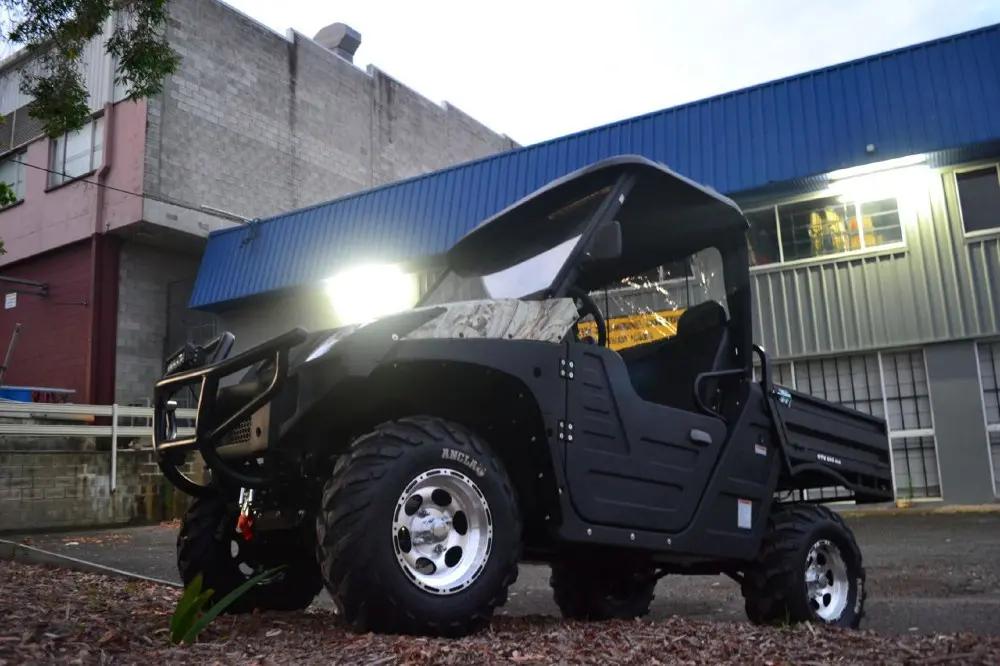
Whisper-quiet electric utility vehicle with bright LED headlights, perfect for early morning or late-night estate operations.
Chapter 1: Unmatched Cargo Capability—The Engineering of the Cargo Bed
1.1 Breaking Free from the Ordinary Golf Cart
Many standard, current golf carts simply can’t keep up with the real-world needs of today. These Personal Transportation Vehicles PTVs are primarily engineered for transporting individuals with minimal or no cargo across the smoothest of terrains. They simply aren’t equipped to handle tough commercial jobs such as hauling large amounts of wet dirt, towing landscaping trailers, or transporting bulky maintenance equipment. Standard carts tend to break due to excessive chassis stress, motor overheating, and rapidly draining batteries.
A standard electric vehicle with an integrated heavy-duty cargo bed changes that fundamentally—from the chassis up—It is not just another golf cart with some bolted-on, flimsy plastic seats in the back that fold into a storage tray; these Professional electric utility vehicles are specifically designed with a reinforced, rear dedicated chassis engineered for hauling cargo.
1.2 Transforming Your Vehicle into a High-Performance Utility Workhorse
The structural cargo bed transforms your utility vehicle from a simple people-mover into an all-purpose industrial workstation that allows ground crews to optimize their daily tasks by consolidating several trips into one haul. Whether you are an estate manager, commercial resort executive, or agricultural worker, think of the vast assortment of materials and equipment your staff has to manage on a day to day basis; Thousands of pounds of damp earth, fertilizer bags, or mulch; Construction tools, ladders, chainsaws, and string trimmers; Resort supplies and housekeeping linens.
With a high-volume, reinforced cargo box, operators will not need to worry about damaging the body of their vehicle or losing cargo along the route, allowing 【electric utility vehicles】 to do things they previously could not.
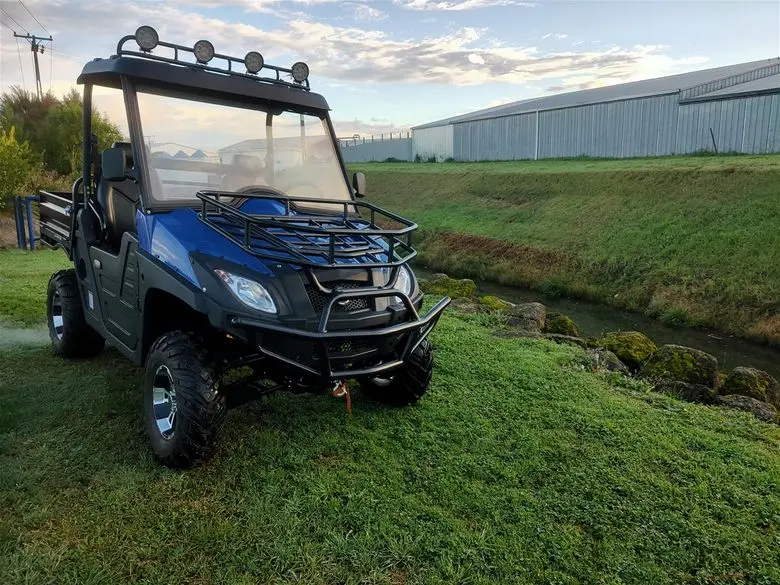
Premium electric utility vehicle engineered for exceptional traction and stability on steep, uneven grass terrains.
1.3 Tough Loads Demand Tough Materials—Engineered Cargo Bed Design
A cargo bed is only as resilient as the materials used in its construction, and when your B2B operations depend on the ability of your electric utility vehicle to handle the weight of loads over difficult terrain, selecting a model with a durable, properly-designed cargo bed made from high-impact polyethylene composites or reinforced heavy-gauge aluminum and steel powder-coat finishing are critical. These tough materials will not rust, crack or deform from high impacts and repeated use, thus ensuring the structural integrity of the vehicle and extending its service life.
Additionally, professional electric utility vehicles come with an abundance of added functionality such as a series of stake pockets, and an integrated quick-release tailgate. This added versatility ensures that you can efficiently haul and secure everything your staff needs for the job.
1.4 Going the Extra Mile With Advanced Cargo Functionality
The cargo bed itself often goes above and beyond just simply holding materials—in premium models you will see that they include a hydraulics or pneumatics-actuated dump bed (or dump box) configuration. In just seconds, a single operator can easily dump out half a ton of soil or fertilizer without the manual strain or worker’s compensation risk typically involved with a full, thirty-minute shovel-dump job, thus improving cycle times and worker safety.
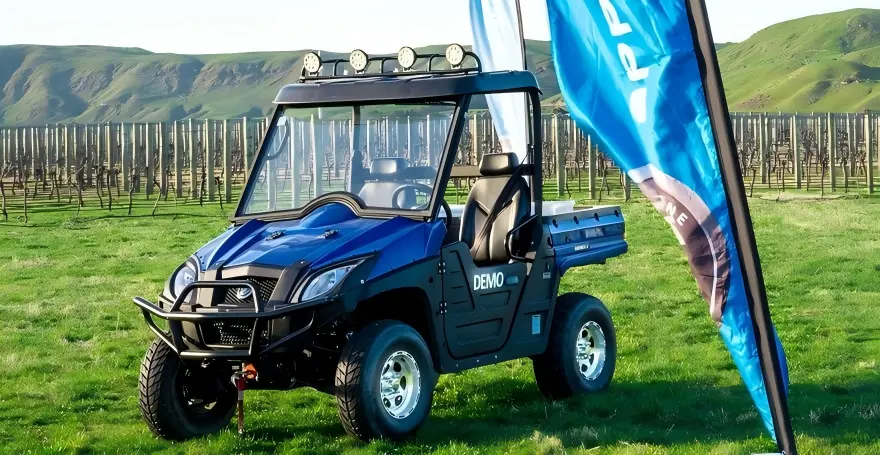
Premium electric utility vehicle engineered for exceptional traction and stability on steep, uneven grass terrains.
2.1 Flaws of Traditional, Rigid Suspension Systems
A driver that must traverse uneven terrain with heavy loads must take more into consideration. If your standard utility vehicle isn’t engineered for such an operation then you have to feel every bump, rock, and rut, and there are two basic systems for suspension in typical work vehicles: solid rear axles and leaf springs, or single trailing arms. Both are designed with economy of manufacturing rather than advanced engineering; a single solid rear axle will transfer any impact force to the chassis, thus making for a rough and bumpy ride, while leaf springs or a single trailing arm suspension allow the axle to shift laterally, making for instability that affects everything from the electronics system to the chassis, themselves, when carrying heavy loads on uneven terrain.
When carrying significant amounts of cargo, even the smallest bump or rut can easily result in catastrophic system failure. Premium models employ Double A-arm, side-by-side independent suspension.
2.2 Anatomy of the 【Double A-Arm System】
This suspension design employs a dual-wishbone configuration—Two triangular-shaped arms (A-arms) extend horizontally from the vehicle’s chassis. Each of these arms is attached to either the chassis or a subframe, and these A-arms secure a vertical upright component, the “spindle.” The wheel assembly (wheel hub and tire) is directly attached to the spindle, with a coil-over shock absorber acting vertically to absorb impacts, while the independent dual-wishbone setup transfers load into the vehicle chassis and a series of lower, parallel-connected suspension linkages.
2.3 Constant Ground Contact & Optimal Traction
Each individual wheel is permitted to move independently when traversing bumps, rocks, or uneven terrain. The independent nature of a Double A-arm suspension greatly reduces body roll and eliminates the shockwave effect associated with solid axles, thereby improving driver control and extending component lifespan. When traversing bumpy terrain, independent suspension ensures the optimal traction needed to safely handle a massive load.
Investing in high-quality Electric Utility Vehicles is the most cost-effective decision for long-term operational success.