Introduction: The Hidden Bottleneck of Off-Road Power
If you’re like most fleet buyers, large-scale farmers, or rugged trail riders buying a new side-by-side or UTV, you’re most likely interested in things like horsepower, top speeds, and towing capability. The reality of the real-world off-road machine, however, is that all that horsepower is absolutely worthless if the chassis can’t keep all of its wheels stuck to the ground.
Hauling half a ton of timber through a muddy forest, spreading fertilizer over uneven pastures, or rock-crawling on a technical mountain path; in every case, a vehicle’s ability to keep its tires firmly planted on the ground is the biggest bottleneck to its performance. In today’s utility vehicle market, the premier off-road chassis suspension setup can be seen as the engineering standard used on nearly all agricultural and commercial utility machines, the Double A-arm independent suspension for side by side.
This guide will explain exactly what that means in terms of physics, how it compares to lower-quality alternatives, and how it directly influences a vehicle’s payload capability, stability, and long-term ROI.
Section 1: Anatomy of a Workhorse – A Look at the Double A-arm Suspension
To understand why a configuration like this is used by many on the American and European agricultural markets, we must examine what goes on physically under the off-road utility vehicle.
What Is a Double A-arm Independent Suspension?
A Double A-arm independent suspension (also called a double-wishbone suspension) consists of two control arms (the upper and lower wishbones, both A-shaped) that are attached to a wheel hub assembly and the UTV’s chassis. Attached through the center of both arms is the coil-over suspension shock absorber.
What is essential in this configuration is the term “independent”—meaning that a bump the wheel on the right encounters will have zero impact on the movement of the wheel on the left, as is typical in the cheaper single-arm or solid-axle designs found on budget utility vehicles.
The Mechanics: Keeping Tires Stable and Predictable
While climbing over massive rocks or deep agricultural ruts, a vehicle wheel will push vertically upward to absorb the impact. During upward movement, standard simple-strut or single control-arm suspension geometry will actually allow the wheel to tilt outwards and inwards, thus allowing it to rotate off of its perpendicular alignment to the terrain—often severely limiting traction when a machine needs it most.
A precisely engineered Double A-arm independent suspension for side by side works differently, utilizing a geometry of unequal length control arms to keep the vehicle’s wheel perpendicular to the terrain, regardless of the obstacle, 100% of the time. This means 100% of your tires’ tread is constantly making contact with the terrain, yielding predictable and steady steering and power application.
Section 2: The Payload Paradox – Dealing with Massive Shifts in Weight
When your fleet vehicle is used for farm and industrial applications, very rarely is that load bay empty. Instead, the machine is typically fully loaded with heavy rocks, a bin full of agricultural supplies, fencing and tool supplies, or heavy industrial liquid sprayers. Managing these extreme shifts in weight without sacrificing stability and control is where Double A-arm independent suspension shines above lesser designs.
Preventing “Sag and Drag”
When a utility vehicle utilizing an inferior suspension design is brought to its maximum cargo weight capacity, the rear of the chassis sags extremely low. This causes 3 critically dangerous problems:
Drastic Ground Clearance Reduction: The bottom of the machine drops near to the ground, rendering it very susceptible to getting stuck on rocks, tree stumps or deep mud.
Front Wheel Steering Lightening: As the rear end dips, the weight is transmitted forward and off of the front wheels, leaving steering much looser and more unresponsive, making climb and descent extremely dangerous.
Complete Destruction of Suspension Dynamic Range: The shocks, already compressed with load, have absolutely zero travel to absorb impact with any obstacles that rise out of the terrain, creating an intensely punishing ride for both the machine and its operators.
How the Double A-arm System Handles Extreme Cargo
A heavy-duty double control arm suspension combined with progressively valved springs allow a high-quality UTV to effectively distribute large amounts of cargo-related weight stress evenly across the reinforced chassis structure.
When the load bay is at its max capacity, the independent design works by pushing stress outwardly, toward the wheel and outward into the more stable, wider stance of the vehicle. This allows for a maintained optimum ride height and plenty of ground clearance, all while keeping weight distributed across all four tires evenly for steady predictable control.
Section 3: Chassis and Drivetrain Synergy – Pairings for Success
When Double A-arm independent suspension for side by side systems are coupled with an intelligent and controllable drivetrain, then you are on your way to the most unstoppable off-road utility vehicle imaginable. Here, we discuss the integration of UTV differential locks.
When Independent Travel and Locking Wheels Combine
Even with independent suspension and a strong frame, there will be situations where an obstacle is so great that one of the vehicle’s wheels lifts into the air or falls into a deep, frictionless patch of mud. This typically happens when attempting to traverse extremely deep V-ditches or when navigating very eroded riverbeds.
If an axle’s wheel is suspended into the air or has lost purchase in a mud patch:
.An Open Differential: Will send 100% of its engine power to the useless, spinning wheel.
.A Locked Differential: Mechanically ties the two sides of the axle together; now, the wheel firmly on the ground and connected to the heavy duty Double A-arm independent suspension for side by side frame can receive 50% of the engine’s torque, easily propelling the vehicle over the impediment.
.Turf vs. Rock: Selectable Drivetrain Control
.Of course, if a manager is operating a high-end commercial landscaping business or a pristine golf course, a fully locked differential can be quite damaging to the perfectly manicured turf it operates upon. The constant locking mechanism under these conditions causes the wheels on the inside of a turn to skip and scuff along the grass.
.To avoid this disaster, the modern superior fleet vehicle must possess features like selective differential locking working alongside its chassis:
.Turf Mode (Unlocked): Ideal for low-impact work on fine grasses and turf. Allows independent wheel speeds for smooth turning without scuffing.
.Fully Locked 4WD: Engages all UTV differential locks for optimal torque distribution across all four tires when tackling any off-road challenge including, but not limited to, heavy mud, soft sand, steep, slick inclines and deep snow, while still leveraging the vehicle’s Double A-arm independent suspension for side by side.
Section 4: Operator Ergonomics and the Bottom Line
The single biggest reason for purchasing a utility vehicle for business use is the productivity enhancement it will provide. If, however, the machine itself is physically damaging to its operators, productivity will suffer immensely and workplace injury liabilities can skyrocket.
The Pain of an Inferior Suspension
Operating a vehicle with an outdated solid rear-axle or poorly constructed single-arm system over a work area like a farm can cause extensive operator fatigue over the course of a 6 to 8 hour day. Every single rock, divot in the terrain or hidden pothole sends an jarring impact straight through the chassis to the operator’s seat. This constant high-frequency vibration results in chronic lower back pain, rapid mental fatigue, and a marked decrease in operator focus toward the end of a long shift.
The Ergonomic ROI of Independent A-Arms
Because a Double A-arm independent suspension for side by side isolates each wheel’s impact, hitting a severe bump on the right side of the vehicle will not cause the left side—or the entire cabin—to violently jerk.
The dual control arm geometry seamlessly neutralizes harsh side-to-side body roll and dampens vertical shocks before they can impact the cabin structural frame. Operators step out of the cabin at the end of a long workday feeling refreshed and injury-free, directly increasing daily task completion rates and boosting overall business productivity.
Section 5: Procurement Analysis – Structural Longevity & Total Cost of Ownership (TCO)
From a pure procurement perspective, buying cheap suspension architectures is one of the most expensive mistakes a fleet manager can make. Let’s look at how suspension choice dictates long-term maintenance costs and vehicle lifespans.
Maintenance Comparison: Single Struts vs. Double A-Arms
Many budget-tier utility vehicles utilize basic MacPherson strut systems or single trailing arms to save on initial manufacturing costs. While cheaper upfront, these systems lack structural rigidity when subjected to the harsh lateral (sideways) forces common in rugged environments.
Si.ngle Struts under Stress: When a loaded vehicle corners sharply or slides sideways on a muddy slope, the entire lateral force is placed directly onto the thin internal piston rod of the single shock absorber, leading to frequent bent shocks and premature suspension failure.
.The Double A-Arm Defense: In a Double A-arm independent suspension setup, all lateral and longitudinal tearing forces are completely absorbed by two massive, heavy-duty control arms anchored to the chassis via durable bushings. The shock absorber is completely isolated from side-to-side stresses and only has to manage vertical dampening. This separation of mechanical duties significantly extends the lifespan of your shocks, bushings, and steering linkages, drastically slashing your fleet’s annual spare parts budget.
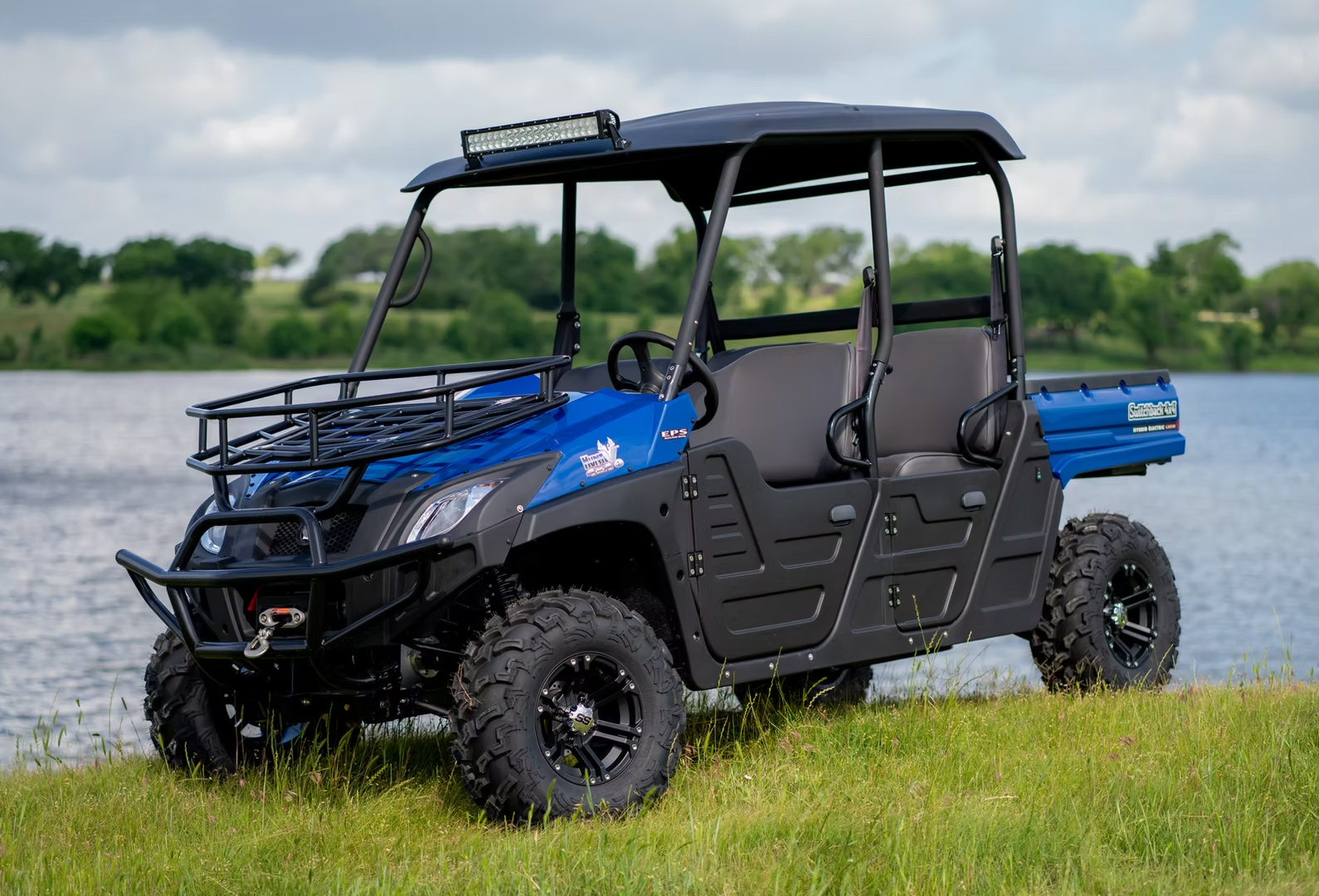
Section 6: Commercial Fleet Selection Matrix
To assist procurement managers in selecting the ideal chassis and drivetrain configuration for their specific regional operations, use the following engineering classification framework:
Vehicle Evaluation Parameters | Premium Double A-Arm + Selective Locks | Entry-Level Strut + Open Differential |
Real-World Weight Capacity | Excellent (Maintains safe ride height & balance) | Poor (Prone to severe sagging and nose-up tilt) |
High-Side Rollover Resistance | Extremely High (Independent tracking lowers center of gravity) | Low to Moderate (Body roll increases rollover risks) |
Tire Lifespan & Wear Costs | Long-Lasting (Camber control ensures uniform tread wear) | Short (Frequent tire scrub and uneven shoulder wear) |
Extreme Terrain Traction | Unstoppable (Combined with UTV differential locks) | Low (Easily stranded when one wheel slips) |
Primary Industrial Use Case | Heavy agricultural hauling, remote forestry, search & rescue | Light landscaping, flat pavement travel, indoor warehousing |